
What looked like one of the biggest breakthroughs of Lorenzo Musetti’s career ended in cruel fashion, while Novak Djokovic walked away from Melbourne Park knowing fortune had once again tilted in his favor. A muscle injury suffered by the Italian, who was leading by two sets, sent the Serbian legend into the semifinals of the Australian Open 2026, where an in-form Jannik Sinner now stands as the final obstacle before the title match.
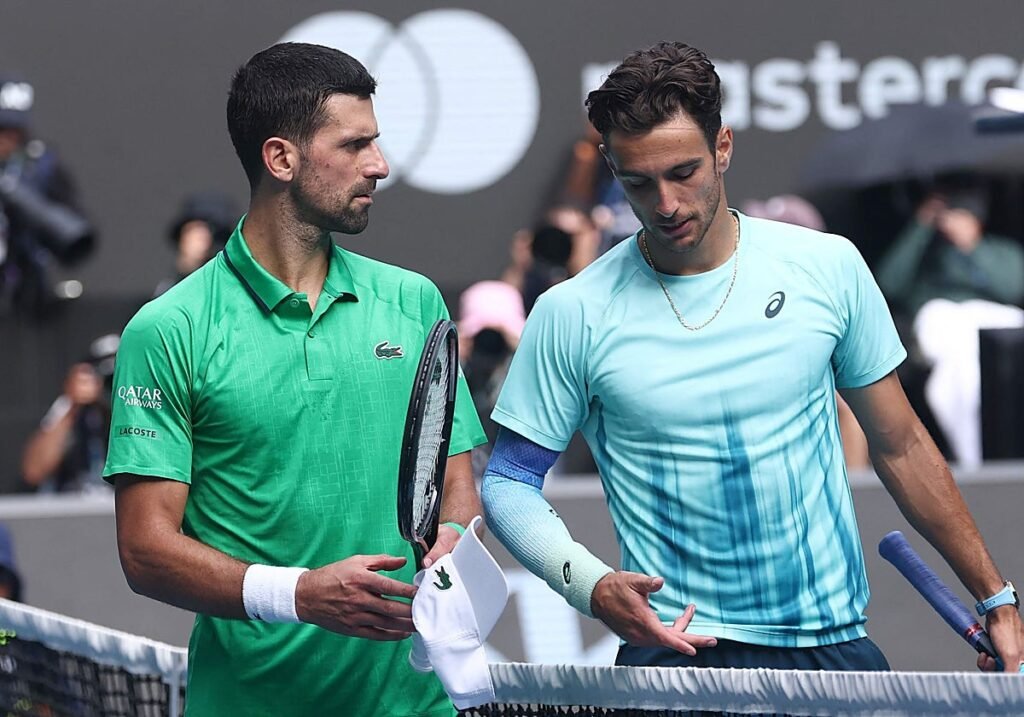
AFP
The turning point came abruptly. Musetti, elegant and inspired, had taken control of the contest with confident shot-making and tactical clarity. Djokovic, visibly uncomfortable, struggled to impose himself. At one stage, as medical staff treated blisters on his foot, the 24-time Grand Slam champion looked resigned to defeat. “I was already thinking about going home,” Djokovic later admitted, a rare public acknowledgment of vulnerability from one of the most resilient figures the sport has ever seen.
But tennis, as Musetti knows too well, can be unforgiving.
A Familiar Story for Musetti
At just 23 years old, Musetti possesses one of the most refined skill sets on tour. His variety, timing, and one-handed backhand make him a joy to watch. Yet, time and again, his body has betrayed him at the worst possible moments. In Melbourne, with the scoreboard reading 6-4, 6-3, 3-1 in his favor, Musetti clutched his thigh and signaled that something was wrong. Moments later, he was forced to retire.
“It’s heartbreaking,” Musetti said afterward. “We did everything in the preseason to avoid this kind of injury. I felt a sharp pain early in the second set, and I knew something had torn. I know my body.”
The scene echoed painful memories from the past. In the 2021 French Open, Musetti also led Djokovic by two sets before cramps and physical distress ended his challenge. Three years later, history repeated itself on the hard courts of Australia. Talent was not the issue. Durability was.
Djokovic Advances — Grateful, Honest, and Realistic
Djokovic, now 38, became the second-oldest semifinalist in Australian Open history, behind only Ken Rosewall. But this was no triumphant march. The Serbian was candid in his assessment, offering sympathy rather than celebration.
“I feel extremely lucky,” he said. “He was playing much better than me. I couldn’t feel the ball in the first two sets because of his variation and quality. I’m very sorry for him.”
Despite the win, Djokovic was far from satisfied with his own level. Sluggish movement, unforced errors, and physical discomfort marked one of his weakest performances of the tournament. Still, survival is a skill — and Djokovic has mastered it better than anyone.
Notably, this was the second consecutive round in which circumstances favored him. In the previous round, he advanced without playing after Jakub Mensik withdrew with an injury. As a result, Djokovic has spent just over nine hours on court across the entire tournament — an ideal scenario given his age and physical demands.
Sinner Stands Firm
Awaiting Djokovic in the semifinals is Jannik Sinner, the reigning champion and arguably the most consistent player in the men’s game right now. The Italian dismissed Ben Shelton in straight sets (6-3, 6-4, 6-4) with clinical efficiency, once again demonstrating why he has dominated the Australian Open in recent years.
Although Sinner experienced physical issues earlier in the tournament due to extreme heat, those concerns now appear resolved. His movement was sharp, his timing precise, and his composure unwavering. Shelton attempted to raise the tempo, but Sinner controlled the rhythm from start to finish.
A Mountain Still to Climb
Djokovic is well aware of the challenge ahead. Sinner has beaten him in their last five encounters and enters the semifinal as the clear favorite. Still, the Serbian refuses to rule himself out.
“My body is holding up, and as long as I’m still here, there’s always a chance,” Djokovic said. “But I’ll need to play much better. Much better.”
The matchup promises a clash of eras: the relentless efficiency of the present against the indomitable will of the past. For Musetti, watching from the sidelines, it is another reminder of how thin the margins are at the top level — and how cruel timing can be.
In tennis, belief can carry you far. But sometimes, fate has the final word.