
Novak Djokovic is once again through to the semifinals of the Australian Open, reaching that stage for the 13th time in Melbourne. On paper, it is another remarkable achievement for the 24-time Grand Slam champion. In reality, however, his path into the final four at the 2026 edition of the tournament has raised eyebrows — and not just among fans.
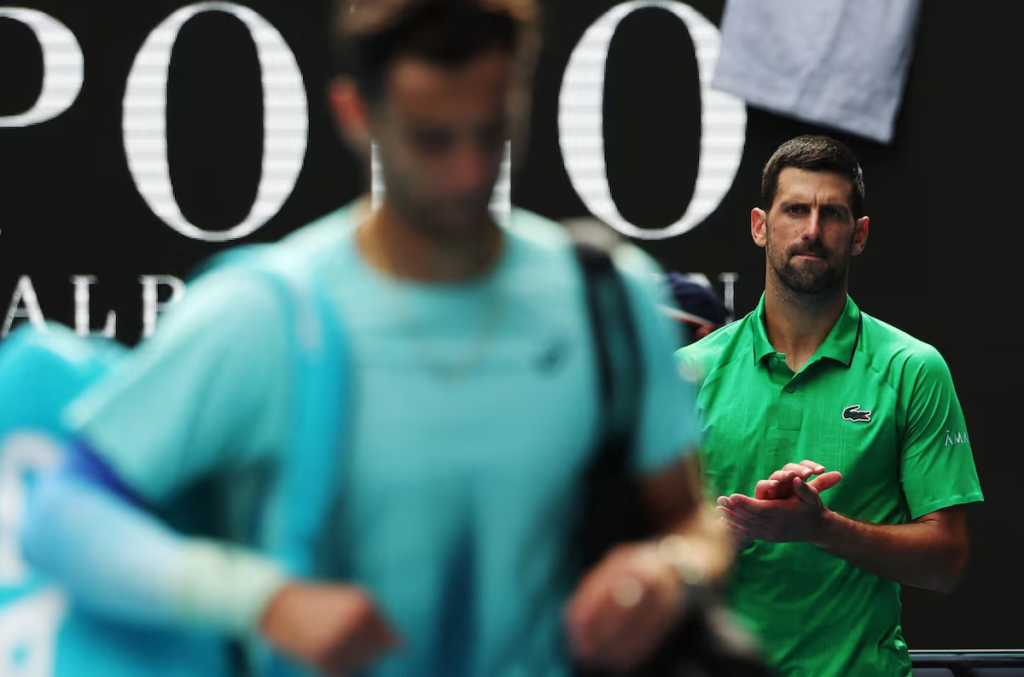
Hollie Adams (REUTERS)
While the scoreboard will show a victory by retirement against Lorenzo Musetti, the performance that preceded the Italian’s injury has ignited serious concern. Djokovic was trailing by two sets and struggling badly when Musetti’s body failed him. The circumstances of that win have prompted sharp criticism, most notably from former Australian Open champion Jim Courier.
Courier’s Unfiltered Verdict
Jim Courier, who lifted the Norman Brookes Challenge Cup in 1992 and 1993, did not mince words in his assessment of Djokovic’s level. Speaking on TNT Sports, the former world No.1 delivered one of the most direct critiques the Serbian legend has faced in recent years.
From Courier’s perspective, Djokovic’s performance during the first two sets — lost 6-4, 6-3 — was far below the standard required to compete for the title, especially with a semifinal clash against Jannik Sinner looming.
“If I were part of his team, I’d want him on the practice court immediately,” Courier said. “An intense hour, playing points, raising the tempo. What we saw wasn’t good enough, and it won’t be enough in a semifinal.”
It was not merely about losing sets. Courier emphasized the manner in which Djokovic was outplayed: flat footwork, predictable patterns, and an uncharacteristic lack of urgency.
A Rhythm Problem Caused by Too Much Rest?
One of the most interesting points raised by Courier was not about age or injuries, but about inactivity. Djokovic advanced through the fourth round without stepping on court due to Jakub Mensik’s withdrawal, leaving him with an extended break before facing Musetti.
In a sport where rhythm is everything, that lack of match play may have backfired.
“Maybe it was the day off, maybe it was the absence of competitive stress,” Courier explained. “But he looked out of sync. When you’re at this level, especially at his age, those details matter. Seeing him struggle like that is concerning.”
The idea that rest could be a disadvantage may sound counterintuitive, particularly for a 38-year-old player, but the evidence from this match was difficult to ignore. Djokovic looked slow to react, uncomfortable in rallies, and unusually passive when trying to dictate points.
Saved by Musetti’s Misfortune
There is no escaping the harsh reality: had Musetti not suffered a muscular injury early in the third set, Djokovic’s tournament would likely have ended on Wednesday evening. The Italian was not only leading but playing with clarity, variety, and confidence — exposing Djokovic’s lack of sharpness.
Courier acknowledged the cruel nature of sport but remained firm in his conclusion.
“Without the injury, Novak is packing his bags,” he said. “That’s the truth. He knows it too.”
Djokovic himself admitted after the match that he was far from his best, a rare moment of vulnerability from a player known for turning adversity into dominance.
Sinner Waiting, and No Room for Error
The timing of this dip in form could hardly be worse. Djokovic now faces Jannik Sinner, the defending champion and arguably the most complete player on hard courts at the moment. The Italian has been ruthless throughout the tournament, showing both physical strength and mental clarity.
Against such an opponent, the margin for error is nonexistent.
Courier was blunt about what lies ahead.
“He has work to do. A lot of it,” he said. “You don’t fix this by talking. You fix it by training, by raising intensity, by finding solutions quickly.”
Experience vs. Reality
Of course, writing off Novak Djokovic has historically been a losing game. His career is built on defying expectations, surviving crises, and producing his best tennis when doubt surrounds him. Melbourne, in particular, has often been his fortress.
Still, even legends are not immune to warning signs.
This time, the criticism isn’t coming from rivals or social media noise, but from a former champion who knows exactly what it takes to win on Rod Laver Arena. Courier’s message was clear: reputation alone will not carry Djokovic through this semifinal.
Whether Djokovic responds with one of his trademark resurrections or whether this tournament confirms a changing of the guard will be decided soon enough. What is certain is that, for the first time in this Australian Open, Novak Djokovic enters a match not as the man to beat — but as the man with everything to prove.