What began as a minor on-court interruption quickly turned into one of the most talked-about off-court debates of the Australian Open. Over the past several days in Melbourne, some of the biggest names in tennis — including Carlos Alcaraz, Jannik Sinner and Aryna Sabalenka — were asked by chair umpires to remove smart monitoring devices worn beneath their wristbands.
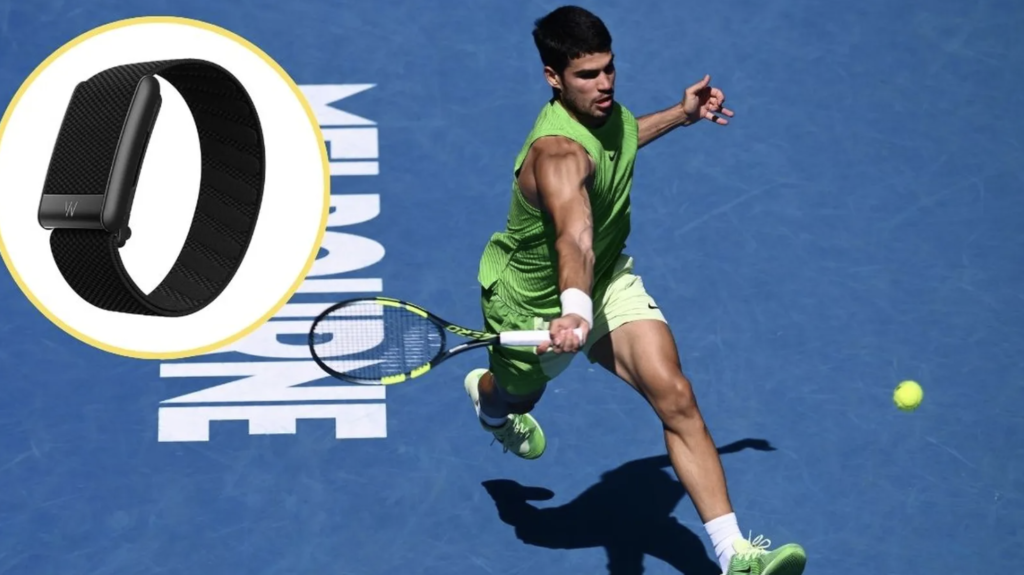
EFE/Amazon
The decision reignited a broader discussion about where elite sport should draw the line between technological progress and competitive regulation, particularly at Grand Slam level.
The Moment That Sparked the Debate
The most visible incident occurred late on Day 9 at Margaret Court Arena, just moments before Jannik Sinner’s fourth-round match against Luciano Darderi. During the pre-match coin toss, chair umpire Greg Allensworth noticed a device under Sinner’s wristband and instructed the world No.2 to remove it. Sinner complied without protest and went on to win the match in straight sets.
Similar scenes had already unfolded earlier in the tournament. Aryna Sabalenka, the WTA world No.1, was asked to take off the same type of device prior to her opening-round match, while Carlos Alcaraz was stopped during the warm-up ahead of his clash with Tommy Paul. A brief exchange between Alcaraz and chair umpire Marija Cicak was caught on camera and quickly went viral.
In each case, the players were wearing a discreet smart bracelet designed to track physical metrics — not to communicate information during play.
What Are These Devices and Why Do Players Use Them?
The device in question is a Whoop wearable, a screenless health and performance tracker widely used across professional sports. It collects data such as heart rate, exertion levels, skin temperature, respiration, oxygen saturation, blood pressure trends, sleep quality and recovery patterns.
Importantly, the data is not displayed in real time on the device itself. Instead, it is uploaded after training or competition and analyzed by players and coaching teams to manage workloads, recovery, and injury prevention.
For athletes competing in extreme conditions — such as the intense heat often experienced in Melbourne — this type of monitoring has become increasingly valuable.
“There are certain physical parameters we’d like to track on court,” Sinner explained after being asked about the incident. “Not to use during the match, but to analyze afterward, especially during tournaments like this.”
So Why Are They Banned at the Australian Open?
The controversy exists largely because tennis regulations are not fully harmonized across the sport.
Wearable technology is currently permitted on both the ATP and WTA Tours. The WTA approved their use in 2021 following a commercial agreement with the device manufacturer, while the ATP followed suit in 2024. At the time, ATP executives highlighted injury prevention and performance optimization as key benefits.
The International Tennis Federation (ITF) has also certified the technology — but with a crucial caveat. Any haptic feedback functions, such as vibrations, must be disabled. According to the ITF, such features could theoretically allow real-time alerts or external input, creating a potential competitive advantage.
Grand Slams, however, operate under their own regulatory framework. For now, all four majors maintain a blanket ban on wearables during match play.
In a statement, Australian Open organizers clarified their position:
“Wearable devices are currently not permitted at Grand Slam events. The Australian Open is involved in ongoing discussions regarding how this policy could evolve in the future.”
Players Accept the Rule — Even If They Question It
Neither Alcaraz nor Sinner made a public issue of the ruling, despite acknowledging the benefits of the technology.
“Those are the tournament rules,” Alcaraz said matter-of-factly. “It helps you manage your body and training load, but if it’s not allowed, you take it off and keep playing.”
Sinner echoed the sentiment, noting that alternatives like chest straps exist but are often less comfortable. “Rules are rules,” he concluded. “I won’t use it again here.”
Sabalenka also complied without incident, though the repeated warnings to high-profile players ensured the topic stayed in the spotlight.
A Broader Clash Between Tradition and Innovation
At its core, the debate reflects a familiar tension in tennis: a sport deeply rooted in tradition confronting rapid technological change. Hawk-Eye, electronic line calling and performance analytics were once controversial themselves. Today, they are essential.
Supporters of wearables argue that banning passive data collection does little to protect fairness while potentially increasing injury risk. Critics, meanwhile, warn that even indirect technological assistance could open the door to real-time coaching or external influence.
For now, the Grand Slams remain cautious.
The Irony: Success Without the Tech
Despite the controversy, the absence of wearables did little to slow down the sport’s biggest stars. Alcaraz, Sinner and Sabalenka all progressed smoothly through their matches at Melbourne Park, proving that elite performance does not depend on a wrist sensor.
Still, the episode left a lingering question behind: as tennis continues to modernize, how long can the sport’s biggest stages afford to resist tools already embraced everywhere else?
The Australian Open may not have changed its rules this year, but the conversation is far from over.