The 2026 Australian Open women’s final is set, and it promises a clash of pure power, consistency, and dominance. Aryna Sabalenka and Elena Rybakina will face each other on Saturday at Melbourne Park after both delivered commanding performances in the semifinals, confirming what many already suspected: the two most imposing players of the tournament have risen to the occasion.
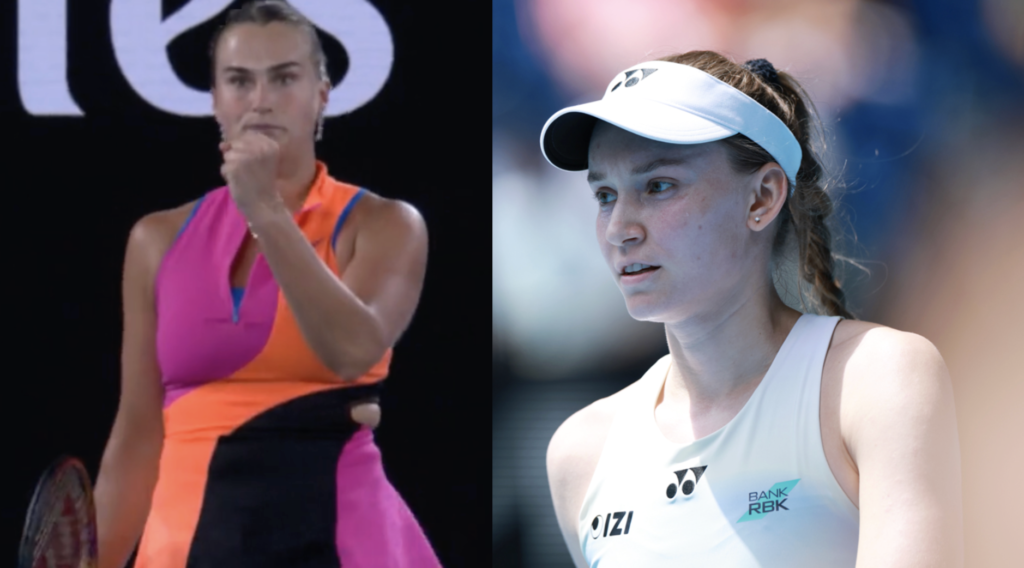
It is not just a final between the world No.1 and one of her most persistent rivals — it is a showdown that reflects the current hierarchy of women’s tennis on hard courts.
Sabalenka’s Relentless Hard-Court Dynasty
Aryna Sabalenka’s straight-sets victory over Elina Svitolina (6–2, 6–3) was more than a routine semifinal win. It cemented her place in tennis history.
With her qualification for Saturday’s final, the Belarusian will contest her seventh consecutive Grand Slam final on hard courts, a streak that began at the Australian Open in 2023 and has now spanned three full seasons. During that stretch, Sabalenka has captured two Australian Open titles (2023 and 2024) and two US Open crowns (2024 and 2025), establishing herself as the dominant force of the era on the surface.
Only two legends of the sport — Steffi Graf and Martina Hingis — have previously managed such a run of hard-court Grand Slam finals, placing Sabalenka in rare historical company.
Against Svitolina, the world No.1 looked utterly in control from the opening games. Her serve was sharp, her returns aggressive, and her ability to dictate rallies left little room for the Ukrainian to maneuver. Sabalenka broke early in both sets and never allowed her opponent to gain momentum, closing the match with clinical efficiency.
Perhaps most impressively, Sabalenka has reached the final without dropping a single set throughout the tournament, underlining both her physical condition and mental sharpness.
Rybakina Overcomes Resistance to Reach the Final
If Sabalenka’s semifinal was a demonstration of authority, Elena Rybakina’s victory over Jessica Pegula required patience, resilience, and nerve.
The fifth seed defeated the American 6–3, 7–6(7) in a high-quality contest that showcased two contrasting styles. Rybakina’s flat, penetrating ball-striking and dominant serve clashed with Pegula’s counterpunching ability and tactical discipline, producing the most competitive women’s match of the tournament so far.
Rybakina controlled much of the first set with her serve, denying Pegula any break opportunities and capitalizing on a single opening to take the lead. The second set, however, was a far tighter affair. Pegula raised her level, extended rallies, and forced Rybakina into uncomfortable positions, pushing the match to a tense tie-break.
After missing three match points, Rybakina finally converted on her fourth, sealing her place in the Australian Open final and completing a flawless run of her own: like Sabalenka, she has also reached the championship match without losing a set.
A Rivalry That Defines the Modern WTA
Saturday’s final will mark the 15th meeting between Sabalenka and Rybakina — a rivalry that has quietly become one of the most compelling on the WTA Tour. Their head-to-head currently favors Sabalenka 8–6, but many of those encounters have been decided by the finest of margins.
What makes this matchup particularly intriguing is the similarity in their strengths. Both players rely on powerful first serves, aggressive baseline play, and an ability to shorten points under pressure. Unlike many rivalries defined by stylistic contrast, this one often comes down to execution, nerve, and small tactical adjustments.
Adding another layer of intrigue is the context: finals between Sabalenka and Rybakina have frequently delivered the highest-quality tennis on the biggest stages, and Melbourne is no exception.
The Best Possible Final
With the semifinals concluded, there is little doubt that the Australian Open has produced its strongest possible women’s final in terms of form and level. The world No.1 against a proven Grand Slam champion. Two players unbeaten in sets. Two athletes who thrive under pressure.
For Sabalenka, Saturday represents a chance to claim a third Australian Open title and further solidify her reign on hard courts. For Rybakina, it is an opportunity to upset the dominant force of the tournament and add another major trophy to her résumé after her Wimbledon triumph and previous Australian Open final appearance.
Whatever the outcome, Melbourne is set to witness a final that reflects the present — and perhaps the future — of women’s tennis: fast, powerful, uncompromising, and decided by the finest of margins.
On Saturday, only one will lift the trophy. But both have already confirmed why they belong at the very top of the game.