
Rafael Nadal may no longer be competing on court at the Australian Open, but his presence continues to loom large over Melbourne Park. The 22-time Grand Slam champion has found himself at the center of attention once again, this time as a spectator, a reference point for the finalists — and potentially, the man who will hand over the Norman Brookes Challenge Cup on Sunday.
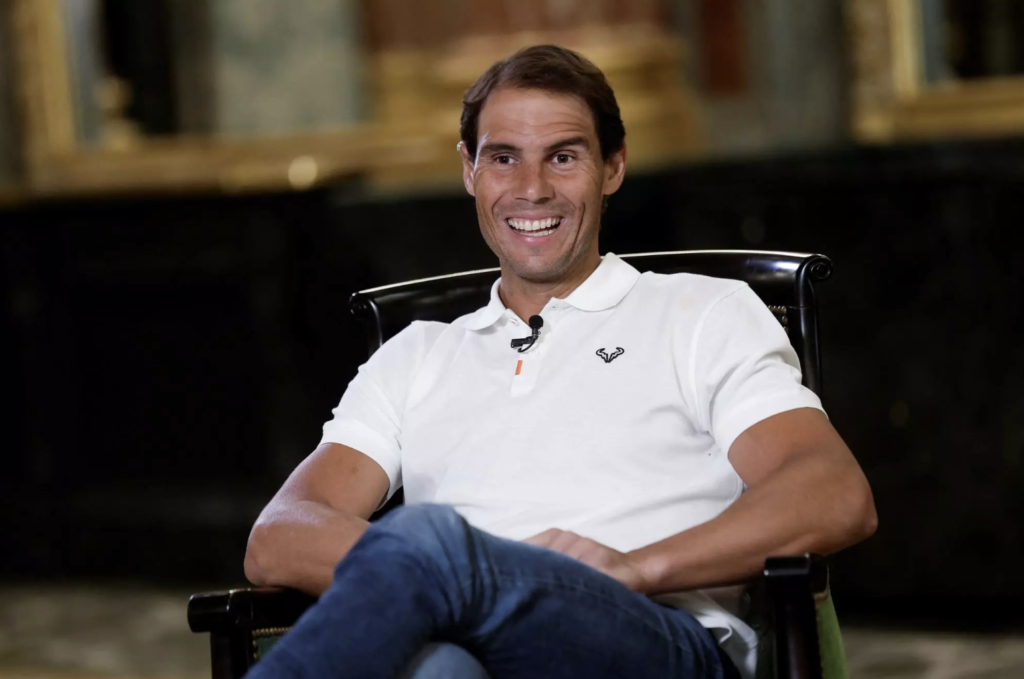
Reuters
Speaking to international media near the Margaret Court Arena, Nadal shared his thoughts on a dramatic semifinal stage that featured Carlos Alcaraz and Novak Djokovic — two players who, in very different ways, have been shaped by the legacy Nadal helped create.
Watching Tennis at 35,000 Feet
Nadal revealed that he followed the action in the most unusual of settings: mid-flight between Manacor and Melbourne.
“I watched the entire match between Carlos and Zverev on the plane,” Nadal explained with a smile. “I landed just as the fifth set of Djokovic and Sinner was starting.”
Those hours in the air, made easier by high-quality tennis, reminded Nadal of how deeply connected he remains to the sport, even away from competition. Coincidentally, just hours later, his name echoed around Melbourne Park as both finalists referenced historic matches involving the Spaniard.
A Name That Keeps Coming Up
After defeating Jannik Sinner in an epic semifinal, Novak Djokovic recalled the unforgettable five-set final he played against Nadal at the Australian Open in 2012 — a match so physically punishing that both players struggled to remain standing during the trophy ceremony.
Carlos Alcaraz, meanwhile, looked even further back in time. Following his marathon win over Alexander Zverev, the Spaniard referenced Nadal’s legendary 2009 semifinal against Fernando Verdasco — another grueling battle that Nadal overcame before lifting his first Australian Open title just 48 hours later.
Nadal listened to both mentions with humility and perspective.
“Everyone walks their own path,” he said. “Obviously, when that happened, Carlos was extremely young — he was five years old — so he wasn’t conscious of any of it. But when you grow up watching what others do, you can be inspired by it. You can develop passion from what you see. That’s something that happened to me, and it could happen to Carlos too.”
Recovery, Fatigue, and the Final Question
One of the key storylines heading into Sunday’s final is physical recovery. Alcaraz endured a five-hour, 27-minute battle against Zverev, while Djokovic also pushed himself to the limit in a long, demanding match against Sinner.
Nadal weighed in carefully, drawing on decades of experience at the highest level.
“I’m sure Carlos will recover, even after such a long battle,” Nadal said. “The other semifinal wasn’t short either, but I think Carlos may have a slightly better chance to recover physically than Novak.”
It was a measured assessment, not a prediction — and one rooted in Nadal’s intimate knowledge of what it takes to survive and win finals in Melbourne.
A Ceremony Filled With Symbolism
Before the championship match begins, the Australian Open will pay tribute to Nadal. He will watch the final from the stands and then take part in the post-match ceremony, a moment the tournament has deliberately kept wrapped in secrecy.
Still, few doubts remain. Nadal is widely considered one of the leading candidates to present the trophy to the champion — a symbolic passing of eras in a stadium where his legacy is etched into history.
Who Does Nadal Want to Win?
When asked directly who he hopes will lift the trophy, Nadal answered with honesty and balance.
“With Novak, we’ve had an incredible history,” he said. “All those years competing for the most important things in tennis. I wish him all the best.”
At the same time, the emotional pull toward Alcaraz was unmistakable.
“Carlos is from my country. I have a very good relationship with him. We shared the Olympic Games together, we shared the Spanish team,” Nadal explained.
Then came the clearest statement of all.
“If Novak wins, I’ll be happy for him — what he’s doing at this stage of his career is spectacular. It wouldn’t be a drama for me at all. But if I have to support someone, I feel I should support Carlos.”
A Bridge Between Generations
As the Australian Open final approaches, Nadal stands in a unique position: a living bridge between eras. Djokovic represents the last towering pillar of a generation Nadal defined alongside Federer. Alcaraz embodies the future — a player who grew up watching Nadal, absorbing his intensity, resilience, and belief.
On Sunday, one will lift the trophy. And nearby, watching closely, will be the man whose shadow stretches across both sides of tennis history — grateful for the memories, proud of the inspiration, and still deeply connected to the sport he helped shape.