
Doha sets the stage: Djokovic, Sinner and Alcaraz headline an ATP 500 that feels like a major event.
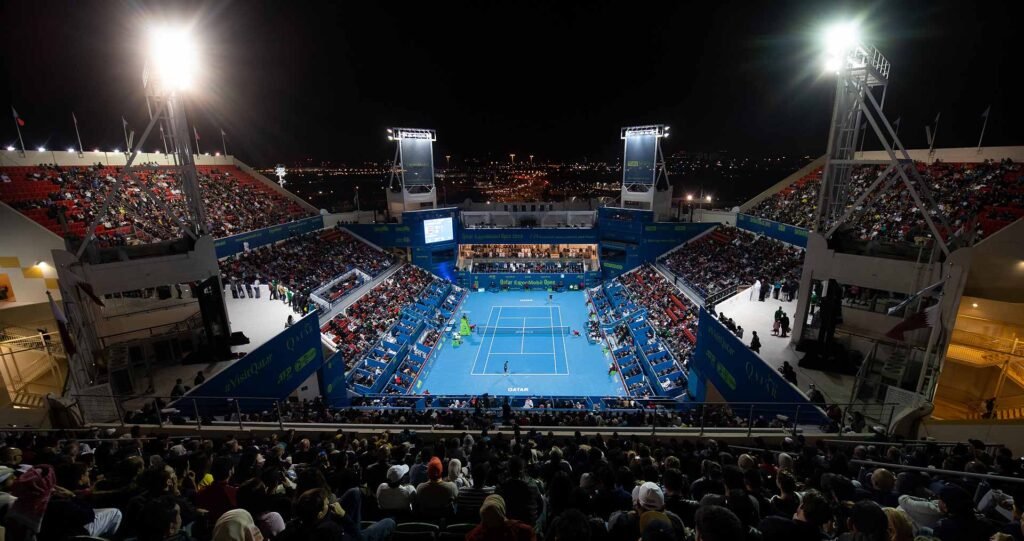
The men’s tennis calendar offers an unusual highlight next week as the Qatar ExxonMobil Open gets underway in Doha. Far from being just another ATP 500 stop, this year’s edition stands out for one compelling reason: Novak Djokovic, Jannik Sinner and Carlos Alcaraz will all compete in the same tournament — a rare concentration of elite talent for an event outside the Masters 1000 tier.
ATP TOUR
Scheduled immediately after the Australian Open and ahead of the North American swing, Doha has positioned itself as a strategic checkpoint in the early part of the season. By attracting three of the sport’s biggest names, the tournament blurs the traditional hierarchy between categories and takes on the feel of a much larger event.
An ATP 500 that breaks the usual pattern
In today’s carefully managed schedules, top players tend to limit their appearances outside Grand Slams and Masters 1000 tournaments. Recovery, workload and long-term planning often dictate lighter calendars, particularly after the physical and mental demands of Melbourne.
Against that backdrop, Doha’s ability to assemble Djokovic, Sinner and Alcaraz in the same week is striking. It reflects not only the tournament’s growing prestige, but also its smart placement on the calendar. Coming after Australia but before the grind of the American hard-court events, Doha offers a competitive environment without the extreme pressure associated with the sport’s biggest stages.
For players seeking high-quality matches rather than rest or lower-intensity competition, this window has become increasingly appealing.
Three stars, three different narratives
While they share the same draw, Djokovic, Sinner and Alcaraz arrive in Doha under very different circumstances — a contrast that adds depth and intrigue to the tournament.
Djokovic continues to operate with a highly selective schedule. At this stage of his career, every tournament he chooses carries weight. His presence in Doha signals a clear intention: to compete in a demanding setting, test his level early in the season, and stay sharp without overloading his calendar. For the Serbian, Doha represents controlled intensity — meaningful matches without unnecessary mileage.
Sinner enters the week in a different phase altogether. Having established himself as one of the most consistent performers on tour, the Italian’s appearance reflects continuity rather than experimentation. Competing regularly, sustaining form and accumulating high-level matches have become central to his approach. Doha’s fast hard courts suit his clean ball-striking and timing, making the tournament a natural fit within his season-building strategy.
Alcaraz, meanwhile, returns to competition after the first major effort of the year. His choice of Doha as a re-entry point is deliberate. The conditions provide an ideal platform to assess his physical and competitive sensations against elite opposition, without the heightened expectations that accompany the sport’s biggest events. It is a measured step rather than a rushed one — a chance to reset and recalibrate.
Conditions built for high-impact tennis
Doha’s hard courts are known for being quick yet reliable, rewarding aggressive play and early ball-striking. There is little room for extended adaptation, which raises the level of difficulty from the opening rounds.
In tournaments featuring this density of top players, early matchups can feel like latter-stage encounters. That reality increases both the risk and the reward. For fans, it means marquee clashes earlier than expected. For players, it demands immediate focus — there are no soft openings.
Historically, Doha has rarely offered comfortable paths. Each round requires full engagement, a dynamic that contributes to the tournament’s growing reputation as one of the toughest ATP 500 events on the calendar.
A tournament with growing stature
Once viewed primarily as a regional stop, Doha has steadily developed a distinct identity. Investment in facilities, consistent organization and strategic calendar placement have elevated its status within the ATP Tour.
This year’s lineup reinforces that evolution. The presence of Djokovic, Sinner and Alcaraz is not simply about star power; it represents a convergence of generations, playing styles and career phases within a single week. That combination is more commonly associated with Masters 1000 events — or beyond.
For the ATP, it also reflects a broader trend: certain 500-level tournaments are increasingly capable of delivering top-tier competition, reshaping how fans and players perceive the category.
Anticipation from the opening day
Even before the draw is finalized, the buzz around Doha is unmistakable. It is rare for an ATP 500 to command this level of attention in advance, and that speaks volumes about the tournament’s current standing.
Each day has the potential to produce matches with long-term implications — not just in terms of results, but in what they reveal about form, confidence and momentum early in the season. Performances here may shape narratives that extend well beyond Doha.
As the first serve approaches, one thing is clear. This is not a routine stop on the tour. With Djokovic, Sinner and Alcaraz sharing the same stage, Doha becomes one of the earliest focal points of the season outside the Grand Slams — a week to watch closely, not only for who lifts the trophy, but for the signals it sends about what lies ahead.