
João Fonseca and an ambition without hesitation: “My dream is to be world No. 1 and win Grand Slams”.
In a sport where every public statement is often carefully calibrated, João Fonseca chose a different path. During his appearance at the Argentina Open in Buenos Aires, the young Brazilian did not dodge the question nor lean on familiar clichés. Instead, he answered directly: “My dream is to be world No. 1 and win Grand Slams.”
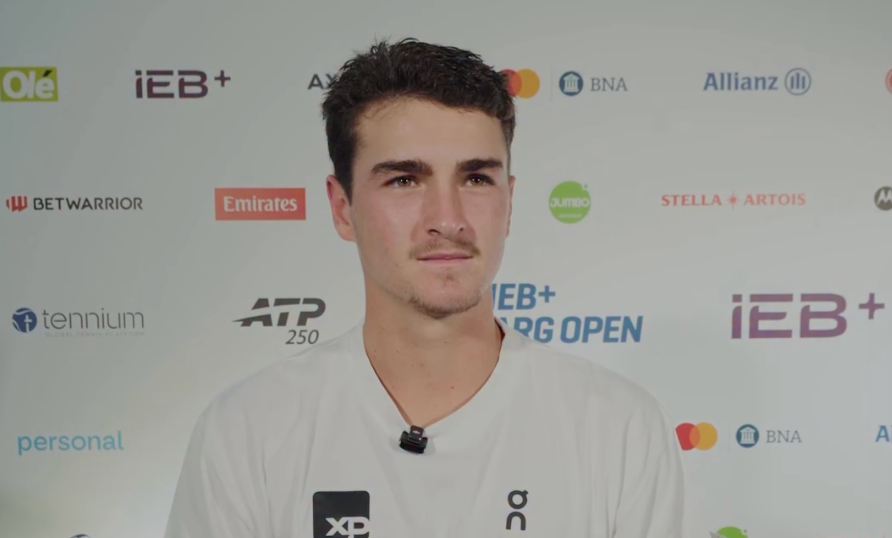
It was a simple sentence, yet one loaded with meaning — because of the timing, the setting and, above all, the profile of the player who said it.
This was not a rehearsed soundbite or a calculated provocation. Fonseca delivered the line naturally during a press conference when asked about his long-term goals. And that is precisely what made it stand out. Rather than speaking in vague terms about “improving day by day” or “seeing how far he can go,” he named the highest possible objectives in tennis, without filters or hedging.
Context matters
Fonseca did not arrive in Buenos Aires as an established figure or a hype-driven prospect built on a handful of isolated results. He arrived as a young player still in the construction phase of his career, far from the top of the rankings, but with a progression that has begun to attract attention within the ATP ecosystem.
The Argentina Open is not a neutral backdrop for statements of ambition. Historically, it is one of the most demanding tournaments for emerging players. The draws are physical, the crowds intense, and the tradition unforgiving. Buenos Aires rarely offers easy entry points for youth. For Fonseca to speak openly about becoming world No. 1 and winning Grand Slams in that environment says a great deal about his competitive personality.
A generation that no longer hides
Fonseca’s words also reflect a broader generational shift. Today’s young players no longer feel compelled to downplay their aspirations in order to appear respectful or patient. Carlos Alcaraz, Jannik Sinner and Holger Rune grew up watching champions speak openly about greatness, and they learned that ambition is not the same as arrogance.
In that sense, Fonseca aligns with a new logic. Saying where you want to go does not imply ignoring the distance still to travel. On the contrary, it clarifies the horizon that shapes daily work. The destination may be far away, but the direction is clearly defined.
Why this statement is not empty talk
What gives Fonseca’s comment weight is not only what he said, but who said it and when. He was not selling a narrative crafted by his team, nor chasing headlines. His response came across as spontaneous, unembellished and almost conversational.
Those who have followed his development note that this mindset did not appear overnight. Fonseca has repeatedly shown a professional approach, an ability to compete without intimidation and a level of maturity that exceeds expectations for his age. Within that framework, speaking about becoming world No. 1 and winning Grand Slams does not feel delusional. It reads as a clearly stated objective — distant, yes, but intentional.
The Brazilian factor and rising expectations
Another element helps explain why the quote resonated so strongly: Brazil. Whenever a Brazilian player with genuine upside emerges, the reaction is amplified. Market size, audience potential and the country’s recent tennis history ensure that any sign of ambition receives heightened attention.
Fonseca is fully aware of that dynamic, yet he did not sidestep the question. That comfort under external expectation may be one of the most intriguing aspects of his profile. He does not appear constrained by what others project onto him, nor interested in portraying himself as something he is not — at least not yet.
Saying it does not make it easier
Declaring big dreams does not shorten the road ahead. Fonseca knows that better than anyone. The ATP Tour is unforgiving, and every step forward requires results, adaptation and resilience. But in a landscape where the margin between stagnation and breakthrough often lies in mindset, defining the goal is part of the process.
His words in Buenos Aires do not alter his ranking or his immediate reality. They do, however, offer insight into how he thinks. And in modern tennis, understanding a young player’s mentality can be just as revealing as analysing his forehand or serve.
A statement that leaves something behind
Ultimately, what makes Fonseca’s comment compelling is not the dream itself, but the ease with which he articulated it. No theatrics. No provocation. No defensive language.
In a circuit saturated with neutral, interchangeable answers, hearing a young player clearly state what he wants to become is notable. It is a signal. And like all early signals, it guarantees nothing — but it deserves attention.
Fonseca has a long journey ahead, filled with challenges and unknowns. Yet his willingness to speak openly about ambition suggests a player who is not afraid of the scale of the task. In a sport where belief often precedes achievement, that may be one of the most important qualities of all.