
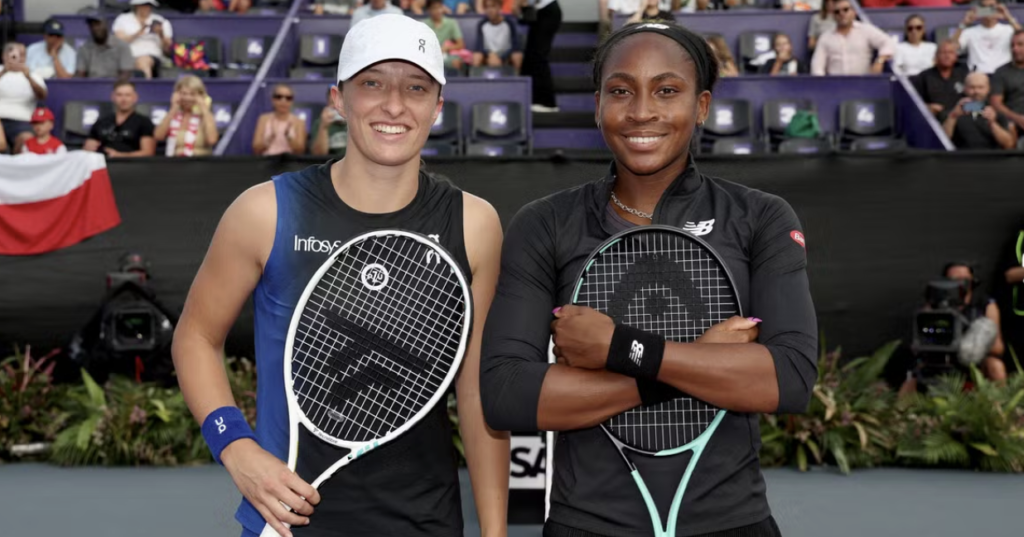
The debate over whether women should compete in best-of-five-set matches at Grand Slams has resurfaced once again — and this time, it wasn’t sparked by controversy or social media noise, but by measured comments from two of the most influential players on the WTA Tour: Iga Swiatek and Coco Gauff.
Should women play best-of-5 sets? Swiatek and Gauff reignite a historic debate in tennis.
Getty
Speaking during the Qatar Open in Doha, and in the context of renewed conversations about Grand Slam formats — particularly following discussions tied to the Australian Open — both players offered thoughtful perspectives on a question that has divided the sport for decades.
At face value, the issue appears simple: should women play best-of-five sets at the majors, as men do? But the answer, as Swiatek and Gauff made clear, is far more complex than a yes-or-no response.
What Swiatek and Gauff actually said
Swiatek, who has held the world No. 1 ranking during multiple stretches of her career, emphasized that the discussion cannot revolve solely around symbolic equality. The Polish star pointed out that the women’s calendar is already physically demanding and densely packed. Any structural change to match length, she suggested, must take into account recovery time, season planning and the broader demands placed on players throughout the year.
She did not dismiss the possibility outright. Instead, she highlighted the importance of context: longer matches mean different preparation cycles, adjusted training loads and potentially restructured scheduling.
Gauff took a slightly more open stance toward the idea, though her position was equally nuanced. The American acknowledged that many players would likely be physically capable of competing in five-set matches — particularly in later rounds. However, she stressed that the conversation cannot focus solely on top-ranked players. Any decision would need to consider the entire tour, including lower-ranked competitors who face different logistical and financial realities.
In short, the question is not just about ability. It is about infrastructure.
A debate that never fully disappears
The five-set discussion in women’s tennis is cyclical. Since the Open Era began, Grand Slams have maintained a best-of-three format for women and best-of-five for men. Over time, that distinction has been challenged on grounds ranging from equality to entertainment value.
Supporters of change often argue:
- Equal match formats at the sport’s biggest events
- Greater dramatic potential in finals
- Alignment with the full professional status of the women’s game
Opponents counter with concerns such as:
- The already demanding WTA calendar
- Increased injury risk
- Structural differences in scheduling and recovery
In recent years, as athleticism and physical standards in women’s tennis have evolved significantly, the argument centered on “capacity” has largely faded. Few now question whether elite players are fit enough. The focus has shifted to sustainability and long-term balance.
What would really change?
Implementing best-of-five matches would involve more than extending playing time. It would require a comprehensive review of tournament logistics:
- Rest days between rounds
- Broadcast scheduling
- Annual calendar structure
- Physical preparation and recovery models
There is also a tactical dimension. Modern women’s tennis is defined by high intensity and narrow margins. Extending matches could reshape competitive dynamics, potentially favoring players with exceptional endurance and altering the profile of champions over time.
Swiatek and Gauff approached the topic with a notable sense of responsibility. Neither framed the debate as a confrontation, nor as a symbolic demand. Instead, both emphasized collective consideration and structural evaluation.
Beyond symbolic equality
One of the most striking aspects of their comments is what they did not say. Neither player defaulted to a simplified equality argument. There was no automatic endorsement or rejection. Instead, they acknowledged the complexity of the ecosystem in which professional tennis operates.
In a sport navigating modernization — from scheduling reforms to expanded prize money parity — format discussions inevitably resurface. But as Swiatek suggested, change cannot be driven by external pressure alone. It must align with the physical realities and sustainability of the tour.
A conversation that remains open
For now, there are no immediate plans to alter the Grand Slam format. But the fact that leading figures of the WTA speak openly about the issue signals that the conversation is alive.
When players of Swiatek’s and Gauff’s stature engage publicly with structural questions, the debate moves from abstract theory to practical consideration. The five-set question is no longer taboo; it is a strategic discussion about the future of the sport.
In modern tennis, where every adjustment has global implications, the real question may no longer be whether women can compete in best-of-five matches — but under what conditions it would make sense to implement such a change.