
Novak Djokovic once again made it clear that his longevity at the top of the sport cannot be explained by technique or physical conditioning alone. At 38 years old, the Serbian spoke in depth about the mental side of elite performance on Jay Shetty’s podcast, offering one of the most candid and revealing reflections of his career.
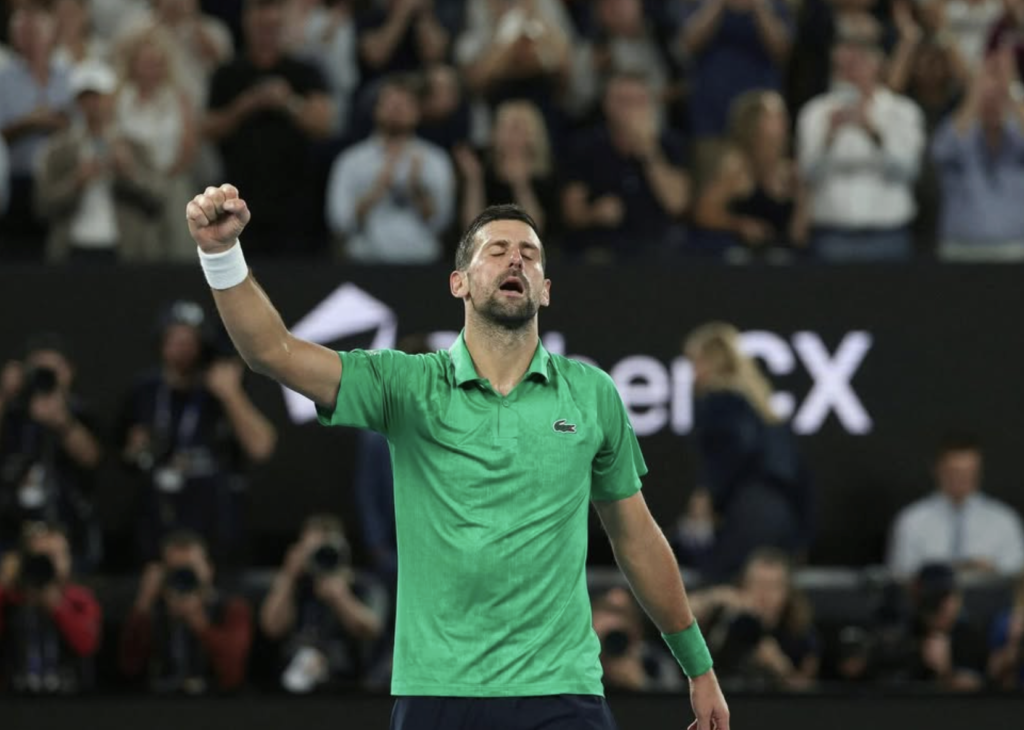
Novak Djokovic and Mental Training at 38: “I Probably Have More Negative Thoughts Than You”
The all-time leader in men’s Grand Slam titles did not talk about forehands or tactical adjustments. He talked about negative thoughts.
“I probably have more negative thoughts, difficult emotions and energies than you. The difference between us is my training and my ability not to stay in that state for too long,” he said.
The statement is not a provocation. It is an explanation.
“Everything depends on practice”: the mind as a trainable muscle
During the conversation, Djokovic expanded on an idea he has repeated at different stages of his career: mental toughness is not an innate gift, it is daily training.
“I stay there for a few seconds… and maybe you stay there longer? I think there’s real wisdom in that. Everything depends on practice. Truly, everything.”
According to Djokovic, the difference is not about avoiding fear or frustration. It is about how long you allow yourself to remain inside those states.
In a sport like tennis, where there are no substitutions and players compete alone for hours under extreme pressure, the ability to emotionally reset within seconds can be the margin between winning and losing a Grand Slam.
What separates champions is often invisible. The crowd sees the serve, the passing shot, the fist pump. It does not see the internal dialogue that precedes the next point.
Spirituality, awareness and daily discipline. Novak Djokovic and Mental Training
Djokovic went beyond the strictly sporting dimension. He addressed the spiritual component of his preparation, something that has been central to his identity for years.
“The brain is a muscle like any other. Even consciousness… We are spiritual beings. We are souls on Earth inside this body. But to connect with your true self, you have to go through layers.”
The idea of “going through layers” connects directly to practices Djokovic has openly defended: meditation, breathwork and visualization routines.
For him, the mind is not trained only in competition. It is trained every single day.
This is not a last-minute strategy deployed in decisive moments. It is a structured discipline, repeated and reinforced outside the spotlight.
Australia 2026: a practical demonstration
The theory had a practical demonstration just weeks ago. At the 2026 Australian Open, Djokovic reached the semifinals and defeated Jannik Sinner in what many framed as a generational test.
The victory was built on composure and emotional control. He endured long rallies, saved every break point he faced and remained calm even as physical fatigue began to show.
It was not a win of raw power. It was a win of mental stability.
Days later, he fell in the final to Carlos Alcaraz. But reaching that stage — competing on equal terms with players ten or fifteen years younger — reinforced his own thesis: a trained mind extends careers.
From outsider to reference point in resilience
In his early years at the top, Djokovic occupied an uncomfortable place within the Federer–Nadal narrative. He was perceived as the disruptor of a rivalry that had already captured the imagination of fans worldwide.
Over time, that role changed. Not because of branding, but because of consistency.
Today, the conversation is no longer about whether he belongs at the same historical table. It is about how he surpassed it statistically and remained relevant while contemporaries retired.
Part of the answer lies in what he explained on the podcast: it is not about eliminating doubt. It is about refusing to live inside it.
The invisible difference in high performance
What Djokovic describes extends beyond tennis. It applies to any high-pressure environment.
The mind generates negative thoughts automatically. Training consists of recognizing them without identifying with them.
In a decisive match, an unforced error can trigger frustration. A break down can activate fear. Most players feel that surge. The difference lies in how long that thought governs the next decision.
Djokovic measures it in seconds.
Those seconds are decisive.
Why this statement matters now
Because it comes at a stage when his career is already consecrated. He does not need to craft a narrative to validate himself. He can speak from experience.
At 38, he is still competing for major titles. In an increasingly explosive and physically demanding tour, his competitive advantage appears internal.
Meditation, breathing routines and emotional discipline are not accessories in his preparation. They are structural pillars.
Beyond tennis
When Djokovic says “everything depends on practice,” he is not referring only to hours on court. He is speaking about mental repetition.
Repeating calm.
Repeating focus.
Repeating the return to the present moment.
That process, invisible to spectators, may be the greatest differentiator in a career that is already the most decorated in men’s history.
At 38, Novak Djokovic is not offering magic formulas. He is offering method.
And in elite sport, method is often more powerful than talent.