
When Daniil Medvedev speaks, he rarely softens the edges. This time, he wasn’t talking about forehands, rankings, or rivalries. He was talking about something far less visible — the silent wear and tear of life on tour.
It wasn’t a complaint. It was closer to a reality check.
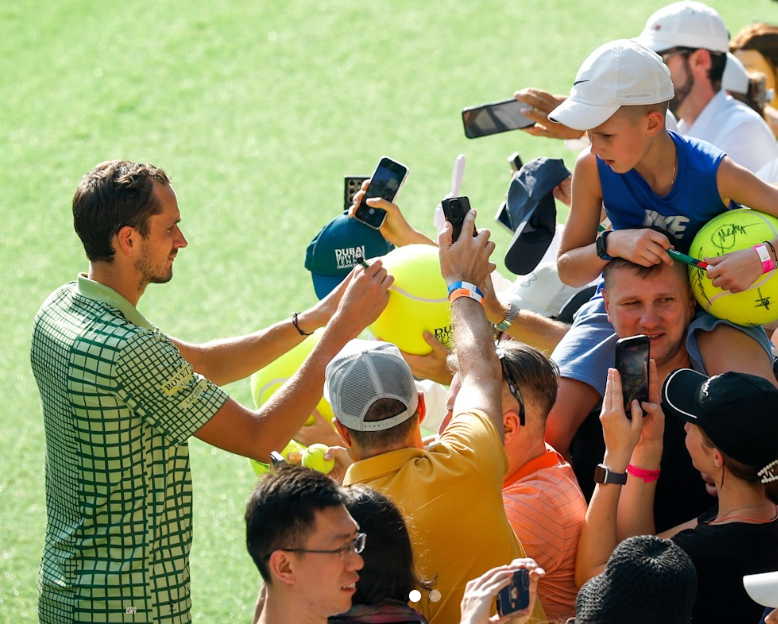
Medvedev and Tennis’ Invisible Grind
“The first thing people see is that we play in front of thousands and earn a lot of money. So they think, what are they complaining about? But then there’s the other side — the part people don’t see.”
That’s where it gets interesting.
The cost that never makes highlights
Medvedev pointed to details that sound minor… until you repeat them 40 times a year.
A different country every week.
A new hotel room.
A new bed.
Different pillows.
Different balls.
Different court speeds.
“The hotel is different, the bed is different, the pillow is different… everything becomes a bit more difficult for the body.”
It may sound trivial. It isn’t.
A top-50 player can change continents every seven days for months at a time. In that context, the body isn’t just competing — it’s constantly adjusting. Recovery becomes adaptation. Routine disappears.
In team sports, athletes often return to a home base. In tennis, there is no base. The travel never stops.
Fatigue you can’t measure. Medvedev and Tennis’ Invisible Grind
One line from Medvedev captures the rhythm of it all:
“Imagine having that feeling around 40 times a year. That’s our reality.”
Jet lag.
Food that doesn’t sit the same.
Languages you don’t speak.
Climate shifts from humid heat to indoor dryness.
And then, the next day, you’re expected to perform.

The hardest part isn’t the travel itself. It’s competing while traveling.
There’s no adjustment window. No buffer week. If you arrive flat, you still play. If your body feels half a step behind, that half step shows up in the scoreline.
Losing doesn’t always mean playing badly
Medvedev touched on something players rarely articulate publicly: perception.
If he loses, the assumption is simple — he wasn’t good enough. But sometimes the context is invisible.
“You might arrive somewhere and get food poisoning. Maybe it’s not bad enough to withdraw, but it’s enough to lose. And people say, how can he lose because of that?”
That’s the disconnect.
The ranking doesn’t care if you slept poorly.
The draw doesn’t adjust for five time zones in three weeks.
The criticism doesn’t wait for nuance.
Tennis is brutally binary. Win or lose. There is no asterisk.
The ranking pressure no one talks about
Medvedev also addressed something deeper — the system itself.
Last year, he played seven consecutive tournaments. He later questioned whether that stretch was necessary. But the math of the ranking system pushes players to keep going.
“You think you can get 100 points here, 200 there… you want to move up. If there were no points involved, it would be easier. But that’s not how it works.”
This is where the sport becomes psychological.
Take a break, and someone passes you. Skip a swing, and your ranking slips. Momentum isn’t just competitive — it’s structural.
Players aren’t only fighting opponents. They’re managing a rolling points system that resets every 52 weeks. Rest becomes a risk.
The mental engine behind it all
Medvedev ended with something that explains longevity better than any technical analysis:
“The hardest part of tennis is everything that comes with traveling, plus maintaining the will to win no matter what happens.”
That word — will — matters.
You can be tired.
You can be uncomfortable.
You can feel out of sync.
And you still have to walk on court with the obligation to compete.
That’s where professional tennis becomes less glamorous and more demanding.
Not a complaint — a reality
It’s easy to hear these reflections and dismiss them as privileged frustration. But Medvedev wasn’t asking for sympathy. He was offering context.
Fans see finals.
They don’t see 3 a.m. airport departures.
They don’t see the recovery sessions in anonymous hotel gyms.
They don’t see the constant recalibration of sleep cycles and routines.
And they certainly don’t see the mental negotiation that happens before stepping on court after another red-eye flight.
Professional tennis is, at its core, a high-performance nomadic life. Travel is written into the contract. Adaptation is assumed. But ease is not guaranteed.
Medvedev didn’t frame it as unfair. He framed it as demanding.
And maybe that’s the point.
Sometimes a loss isn’t just about the opponent on the other side of the net.
Sometimes it’s about everything that came before the first ball was struck.