
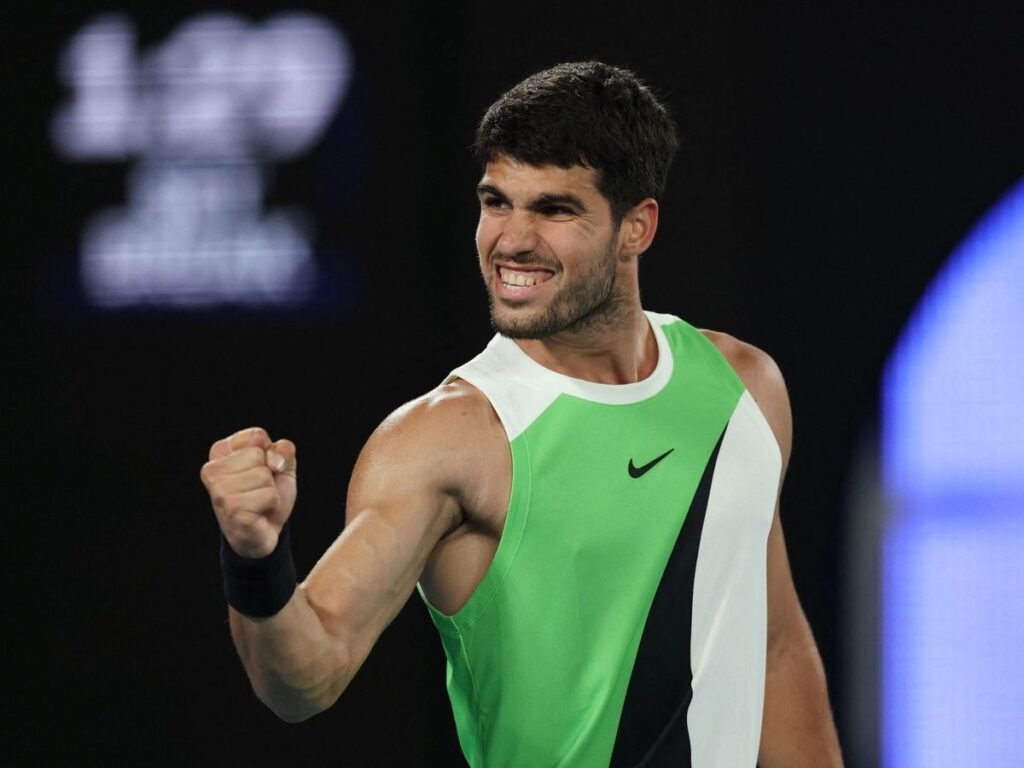
Carlos Alcaraz has added another milestone to his rapidly growing career by reaching the semifinals of the Australian Open for the first time. The world No. 1 secured his place among the final four after a straight-sets victory over home favorite Alex De Miñaur in the quarterfinals, confirming his status as one of the leading contenders for the title.
Reuters
Conquering the Last Unfinished Slam
Until now, Melbourne had been the one Grand Slam that resisted Alcaraz. In his previous appearances, his run had ended at the quarterfinal stage, falling to Alexander Zverev in 2024 and Novak Djokovic a year later. This breakthrough marks a significant step forward in completing his ambitions at the highest level of the sport.
With this result, the Spaniard keeps alive his goal of becoming the youngest player in history to win all four Grand Slam tournaments.
A Noticeable Rise in Performance
Throughout this edition of the tournament, Alcaraz has shown a version of his game that appears more complete and consistent than in past years. His level in Melbourne has stood out not only for results, but for authority, suggesting a player fully adapted to hard courts at the elite level.
Former player and analyst Alex Corretja highlighted this evolution, pointing especially to Alcaraz’s physical development. According to Corretja, the Spaniard now looks “physically and muscularly ready for what modern professional tennis demands,” a key factor in sustaining intensity over long matches.
A New Coaching Chapter
This Australian Open also represents the beginning of a new phase in Alcaraz’s career. For the first time, he is competing without Juan Carlos Ferrero as his primary coach, with Samu López now taking on that responsibility.
Despite the change, Alcaraz has shown no signs of instability. On the contrary, his performances suggest a smooth transition and a strong foundation as he enters a new chapter at the top of the rankings.
Eyes Firmly on the Final
By reaching the semifinals, Alcaraz moves one step closer to lifting the Australian Open trophy for the first time. More importantly, he reinforces the idea that his reign as world No. 1 is built not only on talent, but also on growth, adaptability and physical maturity.
Melbourne no longer looks like unfinished business—it looks like opportunity.