A historic night at Rod Laver Arena crowns the youngest career Grand Slam champion
Carlos Alcaraz produced one of the defining performances of his career on Sunday night in Melbourne, defeating Novak Djokovic in four sets to win the 2026 Australian Open and etch his name permanently into tennis history. The Spaniard rallied from an early deficit to prevail 2–6, 6–2, 6–3, 7–5, capturing his first title at Melbourne Park and becoming the youngest player ever to complete the career Grand Slam.
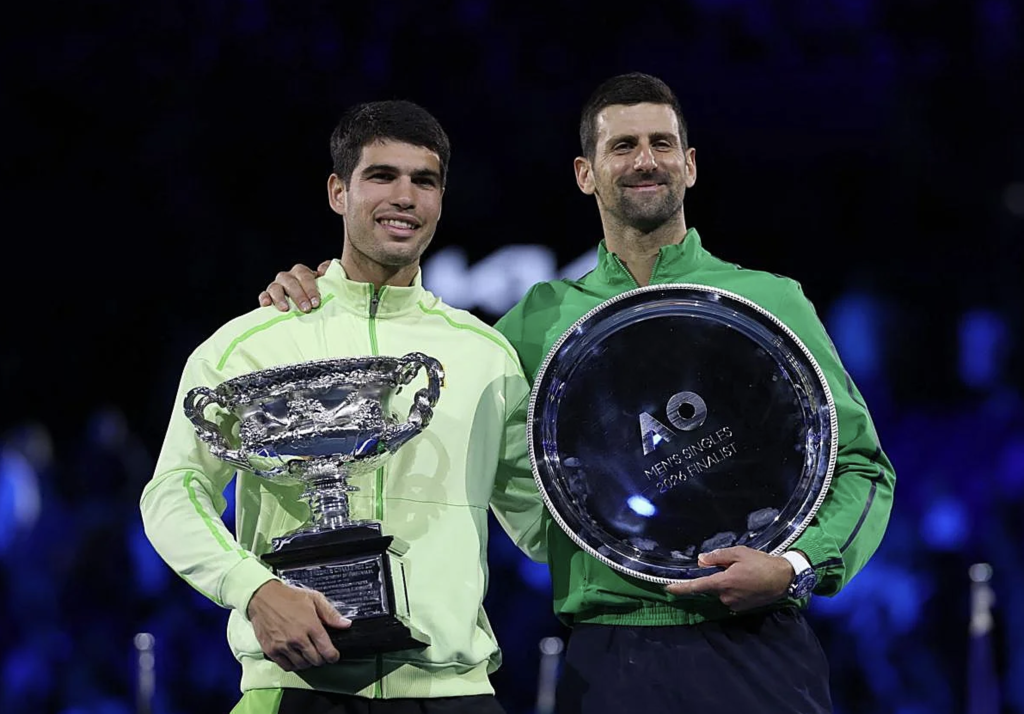
AFP
At just 22 years and 272 days, Alcaraz surpassed a record that had stood since the pre–Open Era, overtaking Don Budge to become the youngest man to win all four major championships. With the victory, he lifted his seventh Grand Slam trophy and the 25th title of his professional career.
From early setback to total control
The final began with Novak Djokovic asserting his authority. The 10-time Australian Open champion dominated the opening set 6–2, using his experience and precision to dictate rallies and expose early nerves from his younger rival.
But Alcaraz responded with composure and growing confidence. He raised his intensity in the second set, finding depth with his forehand and serving more aggressively to level the match at one set apiece. From that point on, momentum shifted unmistakably.
In the third set, the Spaniard struck the decisive blow by breaking Djokovic’s serve in the fourth game. What followed was widely described by broadcasters as “the point of the championship”: a breathtaking rally in which Djokovic defended every corner of the court before finally being overwhelmed by Alcaraz’s relentless attack. The crowd erupted as Alcaraz cupped his ear, feeding off the energy of Rod Laver Arena.
Athleticism, creativity and belief
The match showcased not only power and endurance, but also moments of pure artistry. Early in the third set, Alcaraz stunned spectators with a spectacular between-the-legs shot while chasing a short ball at the net. Djokovic answered with a sharp passing shot to win the point, drawing a standing ovation — a reminder that both players were operating at the highest level of the sport.
Despite Djokovic’s resistance and trademark fighting spirit, the physical toll of back-to-back five-set semifinals began to show. Alcaraz, fresher and increasingly confident, pressed his advantage with heavy forehands and fearless court coverage.
The fourth set remained tight until the closing stages, but Alcaraz broke serve late and calmly closed out the match 7–5, dropping to the court as history was made.
The youngest to conquer all four majors
With this victory, Alcaraz completed a journey that began at the US Open in 2022, continued through Wimbledon and Roland Garros, and now culminated in Australia. He became just the sixth man in the Open Era to win all four Grand Slam tournaments, joining an elite group that includes Andre Agassi, Roger Federer, Rafael Nadal and Novak Djokovic.
He also achieved the feat faster than anyone in the Open Era — just three years, four months and 21 days elapsed between his first and fourth major titles.
Djokovic falls short of history, but legacy remains untouched
For Djokovic, the loss denied him a record-breaking 25th Grand Slam title that would have separated him from Margaret Court atop the all-time list. At 38 years old, the Serbian legend was contesting his 11th Australian Open final, a tournament where he remains the most successful player in history with 10 titles.
Despite the defeat, Djokovic’s achievements in Melbourne remain unparalleled. He has won every Australian Open final he has played, and his overall Grand Slam tally of 24 titles continues to define an era.
Sunday’s final also set a record for the largest age gap between players in an Australian Open men’s final — 15 years and 348 days — symbolizing a generational crossover between tennis royalty and its new standard-bearer.
A rivalry that defines a generation
Alcaraz and Djokovic have now met nine times since 2022, with Djokovic holding a narrow 5–4 edge overall. However, Alcaraz has won three of their five Grand Slam encounters, including both Wimbledon finals in 2023 and 2024, the US Open semifinal in 2025, and now the Australian Open final.
Each meeting adds a new chapter to a rivalry built on contrast: youth versus experience, explosive athleticism versus tactical mastery.
Records achieved by Alcaraz in Melbourne
Alcaraz’s triumph came with a cascade of historic milestones:
- Youngest player ever to complete the career Grand Slam
- Youngest player to win seven Grand Slam titles
- Fifth man in history to be world No.1 and complete the career Grand Slam
- Fastest completion of the career Grand Slam in the Open Era
The final piece of the puzzle
For years, the Australian Open had been the only Grand Slam missing from Alcaraz’s résumé. After consecutive quarterfinal exits — including one to Djokovic — Melbourne had represented unfinished business.
“I came here hungry,” Alcaraz said earlier in the tournament.
On Sunday night, that hunger was satisfied.
Carlos Alcaraz did not just win the Australian Open. He completed the puzzle, confirmed his place among the greats, and announced — once again — that the future of tennis has already arrived.