
Cilic compares the Big Three to today’s generation: “The level hasn’t changed much — the consistency of the second tier has”
During the Dallas Open, Marin Cilic offered one of the most thoughtful reflections of the week when asked to compare the era of the Big Three with the current generation. Rather than leaning into nostalgia or declaring one period superior, the Croatian delivered a more nuanced take: the overall level has not changed dramatically — what has changed is the consistency of the second tier of the tour.
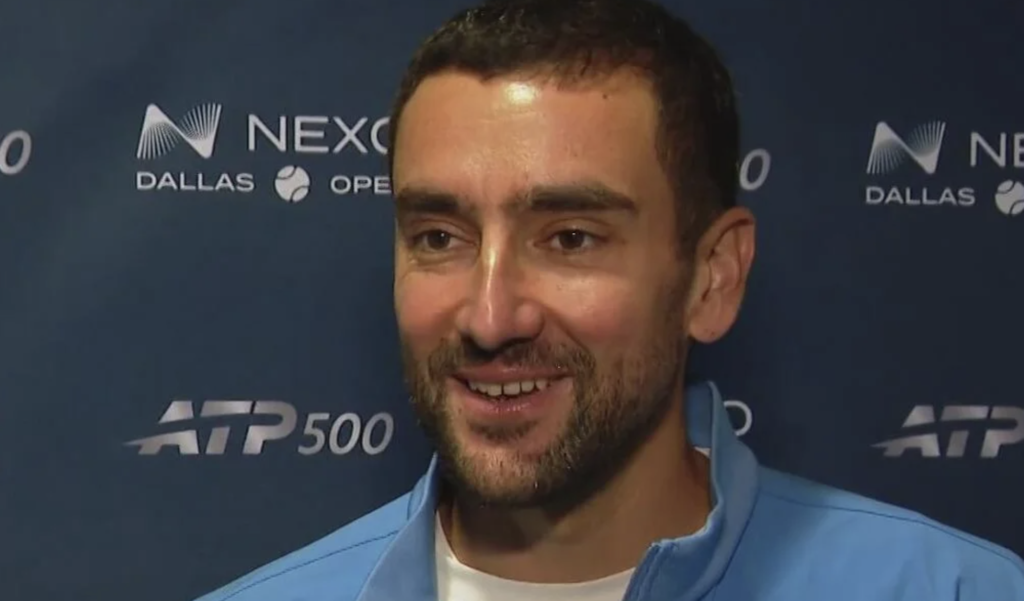
“If we compare level to level, I don’t think there’s a big difference,” Cilic explained. “Ten, twelve or fourteen years ago, though, we had guys who were ultra-consistent, capable of playing week after week at an extremely high level.”
His comments were not limited to Novak Djokovic, Rafael Nadal and Roger Federer. Instead, he pointed to the group orbiting just behind them — the players who, even without dominating the biggest titles, sustained elite standards across seasons.
“There were guys like Tomas Berdych, David Ferrer, Jo-Wilfried Tsonga. They played very well almost every single week,” Cilic noted. “Today, I think the young guys have the level, they compete incredibly well and their tennis is brutal. But that group of players ranked between No. 5 and No. 20 can work on showing that level every week. I’d say that’s the main difference.”
A structural shift, not a decline in quality. Cilic compares the Big Three to today’s generation
Cilic’s diagnosis does not suggest a decline in talent. On the contrary, he acknowledged the extraordinary quality at the top of the modern game, with players like Carlos Alcaraz and Jannik Sinner leading a new era of explosive athleticism and technical precision.
The key distinction, in his view, lies in the “entry gate” to titles. During the height of the Big Three era, even players ranked outside the top four or five were remarkably stable. They routinely reached quarterfinals and semifinals, maintained ranking positions for years and posed consistent threats across surfaces.
Today’s tour, Cilic suggests, may feature similar peaks in terms of raw level, but less sustained collective reliability in that second band of contenders. It is not about brilliance — it is about repetition.
That subtle difference alters tournament dynamics. In previous eras, navigating the draw meant encountering a wall of dependable opposition from the round of 16 onward. Now, fluctuation in form appears more frequent among those ranked just outside the very top.
Djokovic as inspiration
Speaking with Tennis Channel, Cilic was also asked about what it means to see Djokovic — his generational peer — still contending for major titles at 37.
“It’s a total inspiration,” Cilic said. “You can see how committed he still is to the sport, even after reaching the semifinals of all four Slams and suffering very tough losses to Carlos and Jannik. He keeps believing, keeps refining his tennis. In Australia he played more aggressively and got rewarded by reaching the final.”
He then personalized the reflection.
“He’s one year older than me, so maybe I can catch him,” Cilic added with a smile. “He’s extremely professional and diligent with his diet, his mobility, everything related to his body. And you see the results of that every single day.”
For a player who lived the dominance of the Big Three from the inside — reaching Grand Slam finals and winning the 2014 US Open — this is not casual commentary. It is perspective forged through experience.
Still competing, not reminiscing
Importantly, Cilic’s analysis does not come from retirement. It comes from the court. At the Dallas Open, he continued his run by advancing to the semifinals, showing sharp serving and poise in decisive moments on indoor hard courts.
At 37, he remains competitive at ATP 500 level — not as a symbolic presence, but as an active contender.
That context gives his comments weight. He has competed across eras: against Federer, Nadal and Djokovic at their peak, and now against Alcaraz and Sinner as the new standard-bearers.
Beyond nostalgia
What makes Cilic’s remarks compelling is what they avoid. He does not say the past was better. Nor does he argue the present is superior. His point is structural.
The current top of the sport is exceptionally strong. But the collective week-to-week consistency among players ranked between No. 5 and No. 20 may not yet match what Berdych, Ferrer or Tsonga delivered in their prime.
It is a subtle but meaningful observation — one that reframes the generational debate away from simple comparisons of greatness and toward competitive ecosystem.
As the modern era continues to evolve, Cilic occupies a rare position: a living bridge between dominance past and transformation present.
And this Saturday in Dallas, he will attempt to show that his own story — shaped in the shadow of the Big Three and unfolding amid a new generation — is not yet finished.