
Novak Djokovic has spent nearly two decades rewriting the limits of tennis greatness. At 38 years old, with every major title conquered and nearly every record claimed, logic suggests that the Serbian legend has nothing left to prove. And yet, after his dramatic five-set victory over Jannik Sinner in the semifinals of the 2026 Australian Open, Djokovic made it clear that doubt — external and persistent — continues to fuel him.
EFE
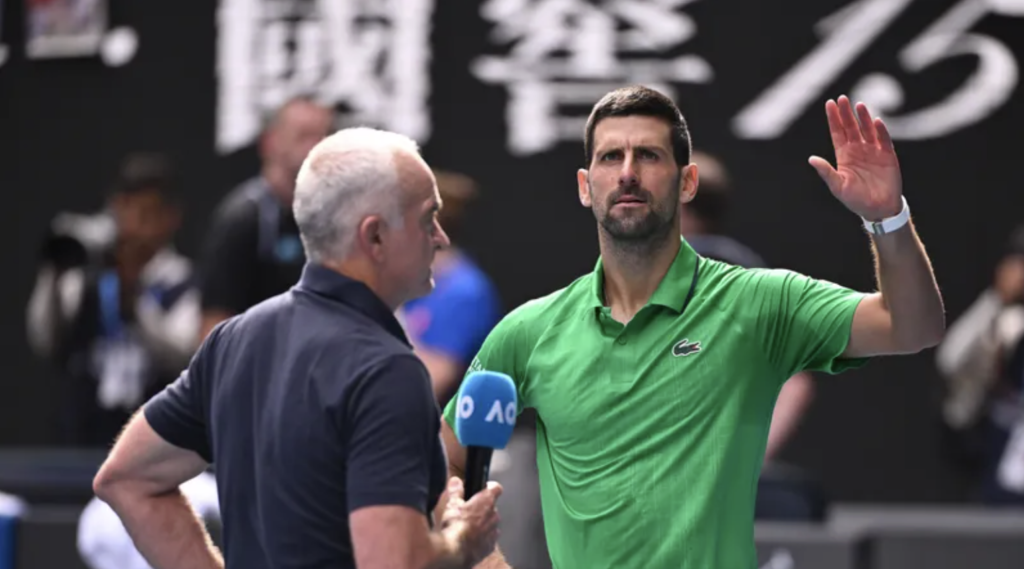
Standing tall after more than four hours of physical and mental warfare against one of the game’s most dominant forces, Djokovic did not shy away from addressing the critics who, in recent years, have openly questioned whether his time at the top was over.
“Many experts wanted me retired already,” Djokovic said bluntly. “So I want to thank them. They gave me strength. They motivated me to show that they were wrong — and tonight, I did exactly that.”
A Victory That Meant More Than a Final
Djokovic’s win over Sinner was not just another semifinal triumph. It was symbolic. The Italian had beaten him in their previous five meetings and, alongside Carlos Alcaraz, represents the new order of men’s tennis. For many observers, this match was framed as a generational checkpoint — a moment where the past would finally step aside.
Instead, Djokovic refused to cooperate with the narrative.
After falling behind multiple times during the match, the Serbian veteran absorbed pressure, weathered Sinner’s explosive serving — including 26 aces — and capitalized on the moments that truly mattered. The final scoreline, 3–6, 6–3, 4–6, 6–4, 6–4, reflected not dominance, but resilience.
“This was not a surprise for me,” Djokovic explained. “I know what I’m capable of. I’ve played many Grand Slam matches where I didn’t feel at my best. The key is finding a way to win, even when your tennis is far from perfect.”
Learning to Survive When Perfection Is Impossible
Djokovic was candid in acknowledging that his tournament had not been flawless. His quarterfinal victory came after Lorenzo Musetti was forced to retire due to injury, and earlier rounds did not showcase his peak form. But experience, Djokovic insists, compensates when brilliance fades.
“Against Musetti, I was not playing the tennis I wanted. I was fortunate with how it ended,” he admitted. “Two days later, I knew exactly what was coming with Sinner. I stepped onto the court with a very clear plan. One thing is imagining how you want to play — another thing is executing it against someone operating at that level.”
That clarity of purpose proved decisive.
While Sinner created 19 break-point opportunities and converted only two, Djokovic held firm in the most critical moments. It was a tactical masterclass built on patience, risk management, and psychological endurance — qualities that have defined his career more than raw shot-making.
Still Fighting, Still Believing
Perhaps the most striking aspect of Djokovic’s post-match reflections was his insistence that belief has never left him — even when doubt crept in.
“I never stopped questioning myself,” he said. “But I also never stopped believing. That’s the difference.”
In a sport where younger legs and explosive athleticism dominate headlines, Djokovic continues to rely on discipline, adaptability, and an unrivaled understanding of pressure. His record at the Australian Open — now an astonishing 104 wins against just 10 losses — speaks louder than any pundit.
Ten titles in Melbourne already sit on his résumé. On Sunday, he will play for an unprecedented 11th.
A Final for the Ages: Djokovic vs. Alcaraz
Waiting on the other side of the net will be Carlos Alcaraz, the world No.1 and the defining player of the new generation. The Spaniard reached his first Australian Open final after surviving a historic five-hour-and-27-minute semifinal against Alexander Zverev — the third-longest men’s match in tournament history.
It will be the third Grand Slam final between Djokovic and Alcaraz, with the Spaniard winning both previous encounters at Wimbledon in 2023 and 2024. Their overall head-to-head favors Djokovic narrowly, 5–4, though Alcaraz has won three of their five Grand Slam meetings.
What makes this final compelling is not just legacy versus youth — it is uncertainty.
Djokovic enters chasing a record-breaking 25th Grand Slam title, which would separate him from Margaret Court atop the all-time list. Alcaraz, meanwhile, has the opportunity to complete his collection of all four majors and become the youngest man in history to do so.
Numbers That Define Two Eras
The statistics underline the scale of the moment:
- Djokovic at the Australian Open: 104–10 record, 10 titles
- Alcaraz at the Australian Open: 17–4 record, first final
- Djokovic in Grand Slam finals: 38 appearances
- Alcaraz in Grand Slam finals: 6 titles from 6 finals
Djokovic’s longevity is staggering. Since debuting in Melbourne in 2005, he has remained a constant presence deep into the second week. Alcaraz, meanwhile, represents efficiency — fewer appearances, maximum impact.
More Than a Trophy
For Djokovic, this final is not merely about silverware. It is about defiance.
Each season, speculation grows louder. Each setback is framed as evidence of decline. And each response, inevitably, is another reminder of why he has endured longer than anyone else.
“I’m still here,” Djokovic seems to say — not with arrogance, but with conviction.
Whether he lifts the trophy on Sunday or not, his message after the semifinal was unmistakable: writing him off remains a dangerous mistake.
The experts may have wanted him gone.
Novak Djokovic simply isn’t finished listening.