Novak Djokovic once again reminded the tennis world why writing him off is a dangerous mistake. At 38 years old, in the early hours of the morning in Melbourne, the Serbian legend produced a performance of extraordinary resilience and tactical mastery to defeat Jannik Sinner in five gripping sets and reach yet another Australian Open final.
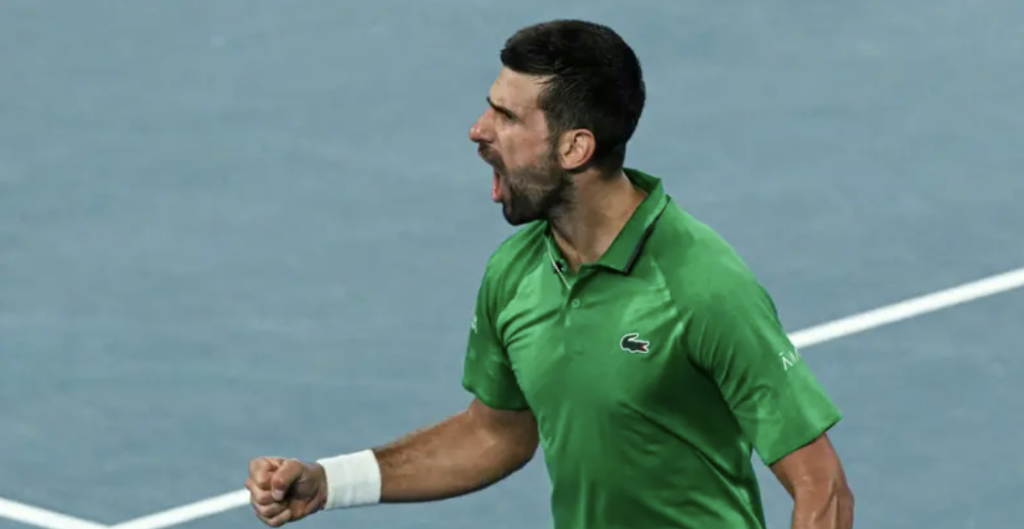
Gettyimages
After more than four hours of relentless, high-quality tennis, Djokovic prevailed 3-6, 6-3, 4-6, 6-4, 6-4, earning a place in Sunday’s final against Carlos Alcaraz — a clash that promises to define a generation.
A Victory Built on Patience and Precision
For much of the night, Djokovic was chasing the scoreboard. Sinner struck first, taking the opening set with authority and repeatedly using his power to dictate rallies. The Italian’s serving was formidable — he finished with 26 aces — and his baseline game pushed Djokovic deep behind the court.
But if Sinner controlled the pace, Djokovic controlled the match.
Time and again, the Serbian absorbed pressure, waited for the decisive moments, and executed with ruthless efficiency when it mattered most. Break points were rare, rallies were physically draining, and margins were razor-thin — yet Djokovic found a way to tilt each critical moment in his favor.
A Mental Battle as Much as a Physical One
The match unfolded as a true psychological duel. Each time Sinner surged ahead, Djokovic responded. Each time the Italian appeared ready to pull away, the 10-time Australian Open champion found another gear.
Djokovic’s ability to manage his energy proved decisive. After benefiting from walkovers in earlier rounds, he arrived fresher than expected for such a demanding semifinal. That advantage allowed him to increase intensity late in the fourth and fifth sets, while Sinner began to feel the cumulative toll of long rallies and missed opportunities.
In the deciding set, the Italian squandered several chances to break serve — moments that Djokovic capitalized on mercilessly. Experience spoke louder than youth.
Tears, Laughter, and History
As the final point was played and Djokovic raised his arms to the Melbourne sky, emotion poured out. During the on-court interview with Jim Courier, the Serbian struggled to hold back tears.
“This feels surreal,” Djokovic admitted. “We played for more than four hours, almost until two in the morning. It reminded me of that six-hour final against Nadal.”
He also joked about finally ending Sinner’s dominance in their recent meetings, having lost their previous five encounters.
“I thanked him for finally letting me win one,” Djokovic laughed. “Otherwise, I might have had to change my phone number.”
Behind him, his coach was visibly emotional as well — a reflection of how much this moment meant.
Numbers That Define Greatness
This victory carries enormous historical weight.
- Djokovic reaches his 38th Grand Slam final, the most by any player in the Open Era.
- It is his first major final since Wimbledon 2024.
- A win on Sunday would secure his 25th Grand Slam title, breaking the all-time record he currently shares with Margaret Court.
- He will be playing for a record-extending 11th Australian Open crown, 18 years after winning his first major in Melbourne.
At an age when most players have long retired, Djokovic continues to rewrite what is possible.
Tactical Brilliance Against Raw Power
What made the performance even more impressive was the contrast in styles. Sinner unleashed power relentlessly, serving big and striking flat from both wings. Djokovic, meanwhile, dismantled the Italian’s game with variety, depth, and defensive elasticity.
He neutralized Sinner’s aggression not by overpowering him, but by redirecting pace, extending rallies, and forcing errors at precisely the right moments. It was a masterclass in match management — the kind only decades of elite competition can produce.
“I didn’t feel the ball at all in some moments,” Djokovic admitted. “But I fought. When you think the point is over, it’s not. He makes you play every ball.”
One Last Mountain: Carlos Alcaraz
Standing between Djokovic and history is Carlos Alcaraz — the world No.1 and the sport’s most electrifying talent. Their rivalry is already one of the defining narratives of modern tennis, with Djokovic holding a narrow 5–4 lead in their head-to-head.
Alcaraz arrives in the final after surviving his own epic semifinal against Alexander Zverev, marked by cramps, courage, and an extraordinary comeback.
Djokovic knows what awaits.
“He’s the favorite,” the Serbian said honestly. “But if my body holds up, there’s always a chance. I just want to compete with him, go toe to toe, and see what happens.”
A Final for the Ages
Sunday’s final is more than a title match. It is a meeting of eras: the greatest champion of his generation against the man trying to define the next one.
For Djokovic, it is a chance to stand alone in tennis history.
For Alcaraz, an opportunity to complete the Career Grand Slam at a record-breaking age.
And for the sport itself, it is a reminder that legends never fade quietly.
Novak Djokovic is still here — still fighting, still believing, and still very much capable of the impossible.