
There are long matches. And then there is what Tomás Etcheverry lived through in Rio de Janeiro. Etcheverry’s 22-Hour Battle in Rio
On paper, it will go down as a semifinal lasting three hours and 43 minutes. In reality, it stretched across nearly 22 hours of lived time — interrupted by rain, extreme heat, multiple stoppages and two decisive tie-breaks. It began Saturday afternoon and ended Sunday around midday. And as if that were not enough, just two hours later the Argentine had to return to court to contest the ATP 500 Rio Open final.
This was not simply tennis.
It was endurance.
A Match That Refused to End. Etcheverry’s 22-Hour Battle in Rio
Etcheverry’s semifinal against Czech player Vit Kopriva started at 5 p.m. Saturday. The first set progressed normally until rain intervened with Kopriva leading 5-4. Suspension. Waiting.
When play resumed Sunday, Kopriva closed the opening set 6-4. At that point, the match changed tone.
The second set became emotional warfare. Long rallies, physical strain, mounting tension. Etcheverry absorbed pressure, held his ground and forced a tie-break, which he won convincingly. Momentum seemed to tilt his way — but the heat turned brutal. Another interruption.
Each stoppage resets not only the body but the nervous system. Muscles cool down. Adrenaline drops. Focus fractures. Restarting becomes a new battle every time.
Hours later, legs heavy and mentally drained, the third set arrived. Again tight. Again without margin. Again a tie-break.
Again Etcheverry.
4-6, 7-6(2), 7-6(4).
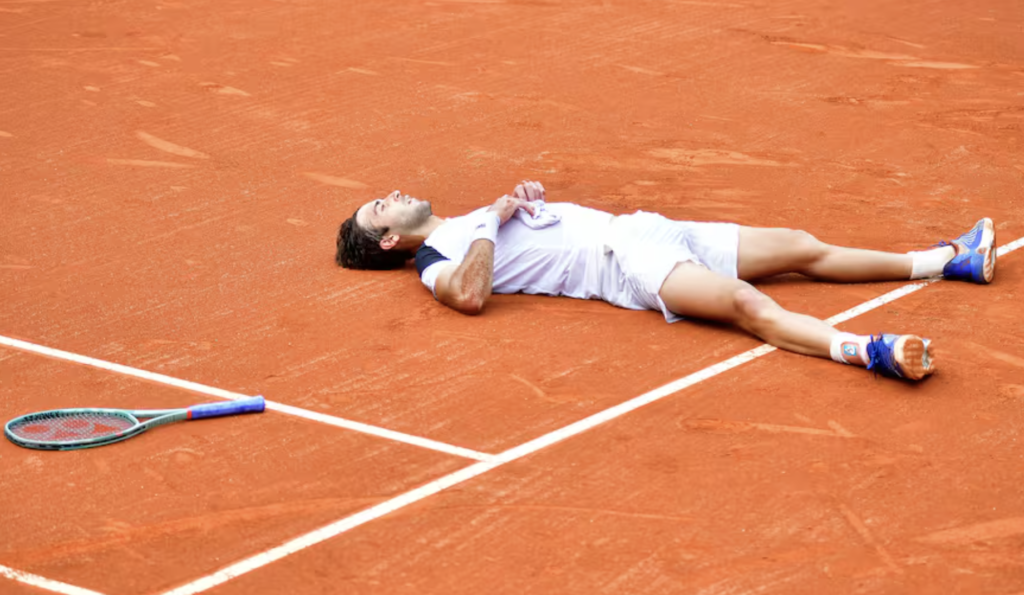
When the final point ended, he did not raise his arms. He did not scream. He did not look to the sky.
He collapsed.
The Fatigue That Statistics Don’t Show
The match time will be recorded as 3:43. That number does not tell the story.
Rio’s conditions were punishing: high humidity, oppressive heat, and constant interruptions. Those factors multiply exhaustion. A player never fully finds rhythm. The body struggles to regulate temperature. Mental sharpness fluctuates.
Every restart becomes a separate test of resilience.
Etcheverry did not win because he struck harder. He won because he did not fracture.
The difference matters.
In decisive moments, he remained structurally intact. He trusted patterns. He controlled emotional spikes. In two tie-breaks, under accumulated fatigue, he executed.
That is not accidental composure. That is competitive maturity.
The Image That Defined It
The final image of the semifinal was stark.
Etcheverry lying on his back, arms spread, completely empty. Not celebration — relief. The kind of release that comes after crossing a psychological line.
There was no trophy yet.
Only another match waiting.
But that semifinal already felt like a private victory. A test passed under abnormal stress.
Two Hours Later: A Final
The semifinal ended around 3:15 p.m. The final was scheduled for 5:30 p.m.
Two hours.
That is not recovery. That is survival mode.
Etcheverry would face Chile’s Alejandro Tabilo for his first ATP title. The stakes layered themselves: a 500-level trophy, South American clay, a career milestone within reach.
Fatigue complicates everything in that scenario.
When the body approaches depletion, tennis becomes a strategic exercise more than a physical one. The next match cannot be played the same way as the previous.
What Is Really at Stake
In situations like this, the final is decided by management rather than force.
Energy allocation.
Point shortening.
Service efficiency.
Shot selection under stress.
Etcheverry cannot afford another three-hour emotional war. He needs clarity. He needs efficient aggression. He needs to recognize when to press and when to conserve.
The semifinal demonstrated that he can endure.
The final demands intelligence.
Beyond the Scoreline
Sometimes tennis produces stories that transcend scoreboards.
Rio offered one.
This was not just a long match. It was a contest shaped by climate, interruption, tension and accumulated strain. It tested physical resistance and psychological elasticity.
There are players who win matches.
And there are players who survive them.
Tomás Etcheverry has already done the second.
Now he must attempt the first.
If he manages to convert that ordeal into a title, it will not simply be an ATP trophy.
It will be the moment when extreme effort found tangible reward.