
Karolína Muchová conquers Doha and halts Mboko’s surge: first WTA 1000 title and a high-level final in Qatar
Karolína Muchová captured the biggest title of her career on Sunday, defeating Victoria Mboko 6-4, 7-5 in the final of the Qatar TotalEnergies Open. In a 1-hour, 34-minute battle defined by tactical nuance and controlled aggression, the Czech outmaneuvered one of the tour’s fastest-rising players to lift her first WTA 1000 trophy.
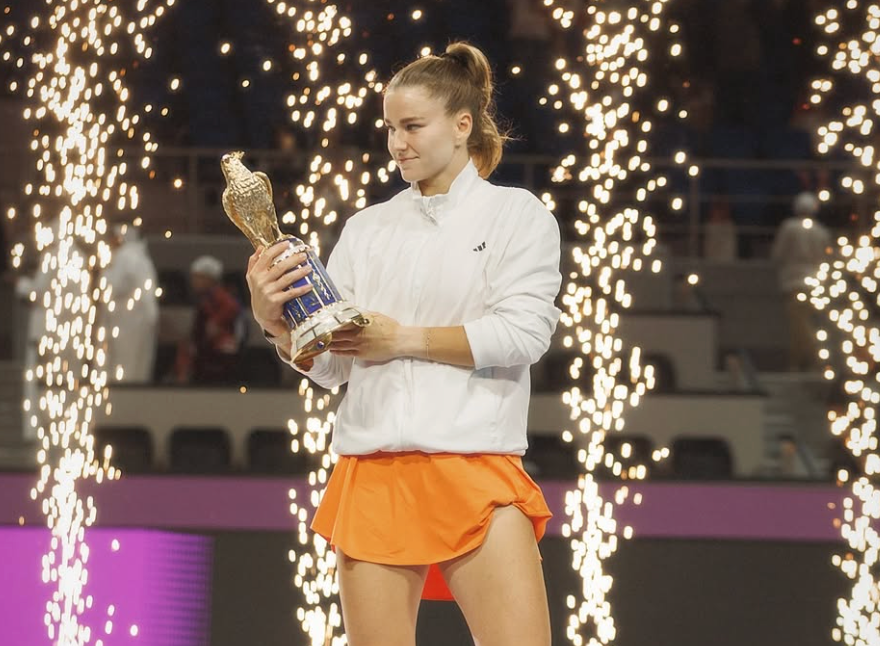
This was not just another title. It was Muchová’s first trophy of any kind since 2019 and, crucially, her maiden WTA 1000 crown — a milestone that had long seemed inevitable for a player widely regarded as one of the most versatile talents on tour when healthy.
A final of contrasts: variety versus raw power. Karolína Muchová conquers Doha
The matchup presented a clear stylistic clash. Mboko arrived in Doha riding a wave of explosive, first-strike tennis, built on depth, pace and a willingness to dictate early in rallies. Muchová, by contrast, brings a rare toolbox to modern women’s tennis: slice backhands, changes of height, sharp angles and well-timed net approaches that disrupt rhythm.
The match largely unfolded according to that script.
In the opening set, Muchová’s 6-4 edge came from pattern discipline. She refused to let Mboko settle into straight-line power exchanges. Instead, she mixed trajectories, broke timing and selectively accelerated when openings appeared. It was not about overpowering the Canadian — it was about forcing her to hit one more uncomfortable ball.
The second set carried more tension. Mboko raised her level, stepping further inside the baseline and briefly taking the initiative. But Muchová’s defining trait — patience under pressure — surfaced again. She resisted the urge to rush points, absorbed pace when necessary and chose her moments to step forward. The 7-5 finish reflected composure more than momentum.
How the final was built: semifinal statements
The title match was shaped by two revealing semifinals.
Mboko had delivered a commanding performance against Jelena Ostapenko, winning 6-3, 6-2 in a display that erased any notion her week was a fluke. That victory reinforced her growing presence in the upper tier of the rankings conversation.
Muchová, meanwhile, advanced by staging a controlled comeback against Maria Sakkari, 3-6, 6-4, 6-1. That semifinal revealed her adaptability: adjusting tactics mid-match, increasing physical intensity late and reclaiming tempo through variation rather than force.
By Sunday, both players had earned their place through substance rather than surprise.
A long road back for Muchová
What elevates this title beyond ranking points is context.
Muchová’s career has been defined by brilliance interrupted by injury. Wrist problems and other physical setbacks sidelined her for extended stretches in recent seasons, halting momentum just as it seemed to be building. The six-year gap between titles underscores how significant this moment is.
She had already proven she could reach the latter stages of majors. What she had not yet done was close out a WTA 1000 week. Doha answers that question decisively.

Winning seven matches at this level requires durability — physical and mental. For Muchová, it signals not just peak tennis, but sustained readiness.
Mboko’s breakthrough week, even in defeat
For Mboko, the final loss does little to diminish the broader narrative.
Her Doha campaign — highlighted by a major upset earlier in the tournament and a series of composed performances under pressure — positions her firmly in the race for a Top 10 debut. More importantly, it suggests evolution. She no longer relies exclusively on outright winners; her point construction has matured.
This final marked the first time she carried sustained expectations across multiple rounds in a WTA 1000 event. Even in defeat, she handled that burden with poise.
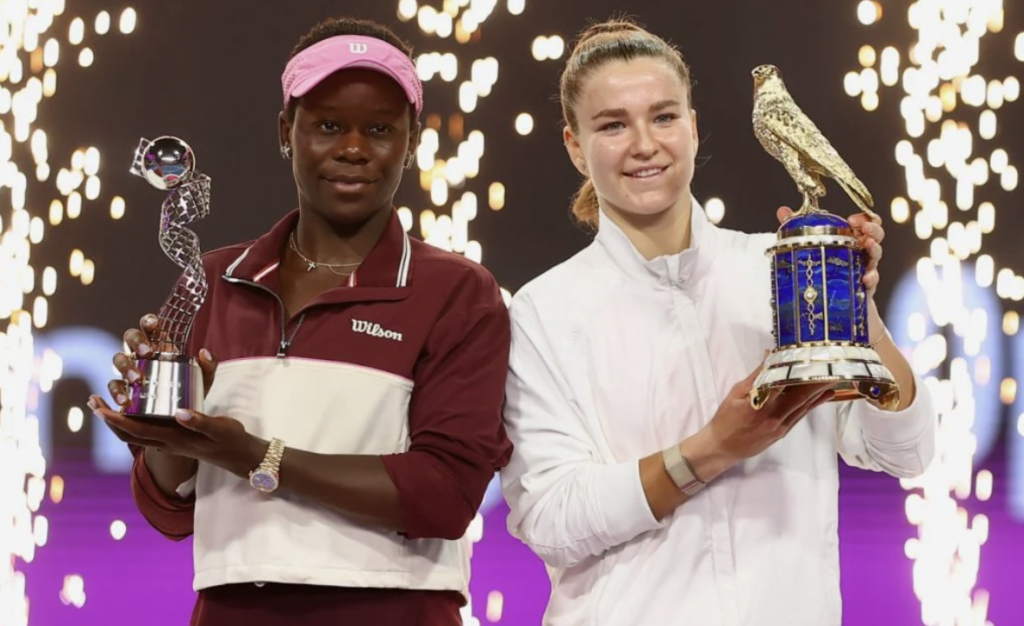
Often, the true breakthrough comes not from the trophy itself but from the ability to reach this stage consistently. Mboko leaves Qatar with validation.
What Doha means for the WTA landscape
The Doha final sends two strong signals across the tour.
First, Muchová’s return to the winner’s circle confirms that her ceiling remains among the highest in the sport. She is not simply a stylistic outlier admired for elegance; she is once again a title contender at the biggest non-Slam events.
Second, Mboko’s rise appears structural rather than episodic. The combination of power, improved tactical judgment and competitive composure suggests she will not be a one-week storyline.
The elite remains demanding, but the map is shifting. Doha provided both confirmation and transition: a long-awaited coronation for Muchová and a formal arrival for Mboko.
One leaves with the trophy she had been chasing for years. The other departs with proof that her next step is no longer theoretical — it is imminent.