
It’s not the dream scenario for lifting a trophy.
But it’s not an accident that Daniil Medvedev was the one standing there.
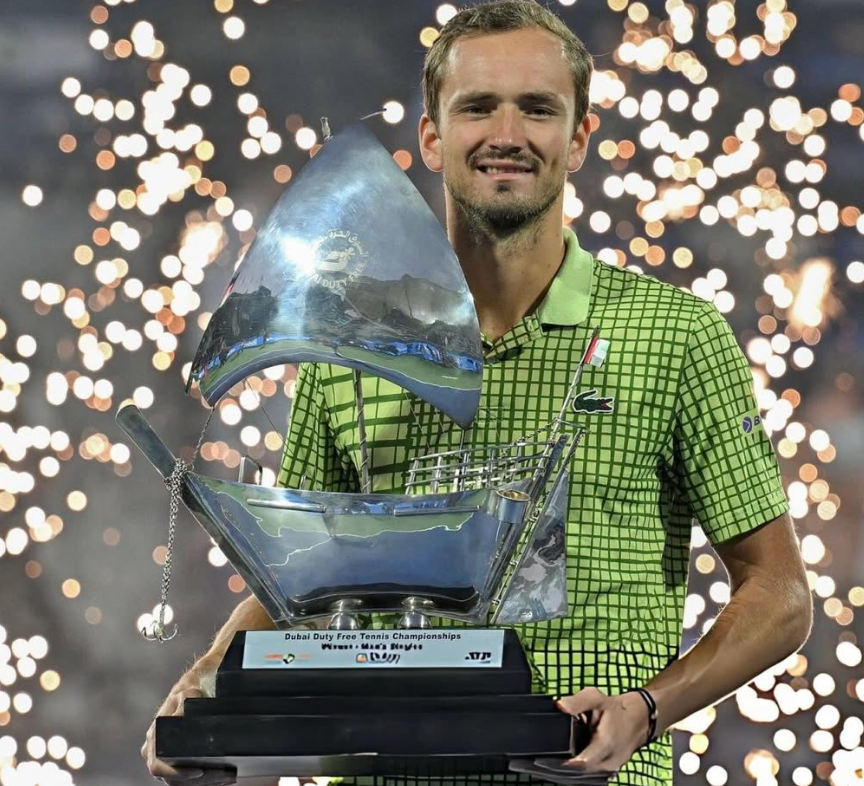
Medvedev wins Dubai title without final
The Russian was crowned champion of the ATP 500 in Dubai without playing the final after Tallon Griekspoor withdrew due to a muscle injury suffered in the semifinals. The decision came just hours before the title match, creating an unusual image: the trophy awarded without a final point being played.
Still, if you look at the full week, it’s clear this wasn’t a gift.
The opponent who couldn’t take the court
Griekspoor had come through a physically demanding semifinal against Andrey Rublev. He won it in straight sets, but not without visible discomfort. During the match he struggled with his hamstring, and although he finished the contest, recovery proved impossible overnight.
The hamstring injury forced him to pull out before the final.
No formal warm-up.
No player walk-on.
No championship match.
For a competitor like Medvedev, that always leaves a slightly unfinished feeling.
What Medvedev did to earn it. Medvedev wins Dubai title without final
The absence of a final doesn’t erase the path.
Medvedev’s run in Dubai was controlled and efficient. In the semifinals he defeated top seed Félix Auger-Aliassime 6-4, 6-2 in a performance that felt very “Medvedev”: deep returns, relentless rally tolerance, and clinical timing on break points.
He did not drop a set all week.
That matters.
On hard courts, when his first serve percentage is steady and he locks opponents into extended exchanges, Medvedev becomes suffocating. He doesn’t overwhelm with raw power. He drains. He stretches rallies. He forces extra shots.
In Dubai, he combined patience with precision.
A final that promised contrast
The matchup with Griekspoor had intriguing tactical layers. The Dutchman had played aggressive, front-foot tennis throughout the tournament, including his upset over Rublev. His serve and forehand were driving forcefully through the court.
Against Medvedev’s elastic defense and depth, it could have been a compelling stylistic battle.
But the body intervened.
In a tour calendar that runs nearly year-round, that’s no longer rare.
Does it count the same?
Officially, yes.
It’s 500 ranking points. Another ATP trophy. A boost in the race standings. For Medvedev, it marks his 23rd career title and reinforces his reputation as one of the most reliable hard-court players of his generation.
Emotionally, it’s different.
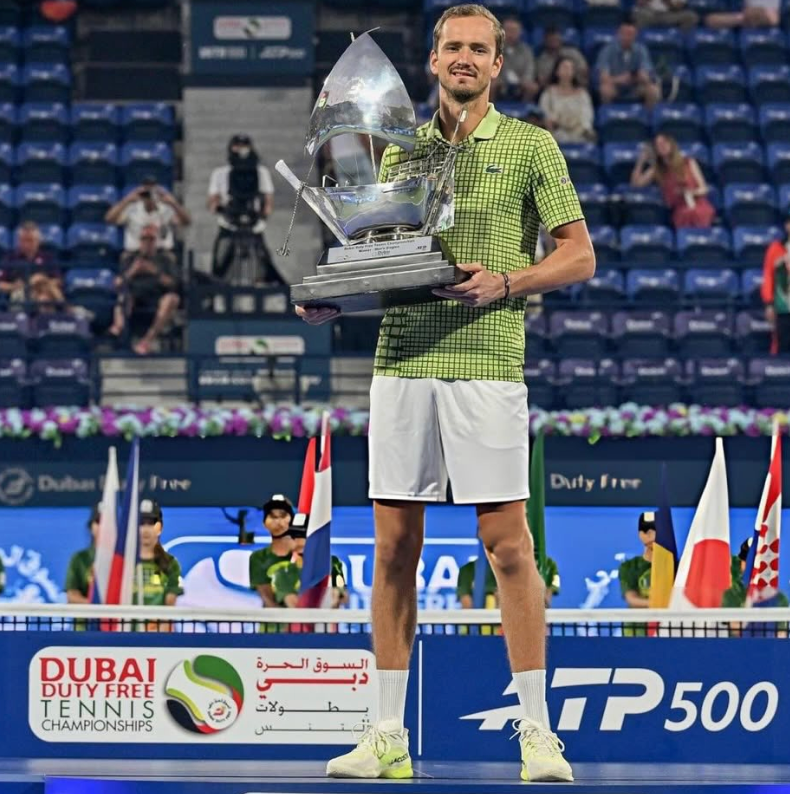
Medvedev is a player who enjoys finishing the job himself. He thrives on closing matches, on solving the final puzzle point by point. Winning without stepping onto the court leaves less adrenaline, less closure.
But championships are built over rounds, not just in finals.
And he had already done the work.
The broader context
There’s also something symbolic about this ending.
Medvedev has been outspoken in recent months about the intensity of the calendar and the physical toll it takes. This week, the evidence was visible: a finalist unable to compete after a draining semifinal.
The modern tour offers little room for recovery. Travel, surface changes, high-intensity matches — the accumulation shows up eventually.
Dubai became another reminder.
What this week really says
Beyond the unusual finish, the more important takeaway is that Medvedev looks settled.
His serve was sharper.
His decision-making in pressure moments was cleaner.
He stayed composed in longer exchanges rather than rushing to shorten points.
It wasn’t a flashy week.
It was a controlled one.
For a former world No. 1 who has already experienced the peaks and dips of the tour, that kind of stability can be more significant than spectacle.
Medvedev didn’t play the final.
But he earned the Sunday.
And in professional tennis, getting there without cracks in your level is already half the battle.