
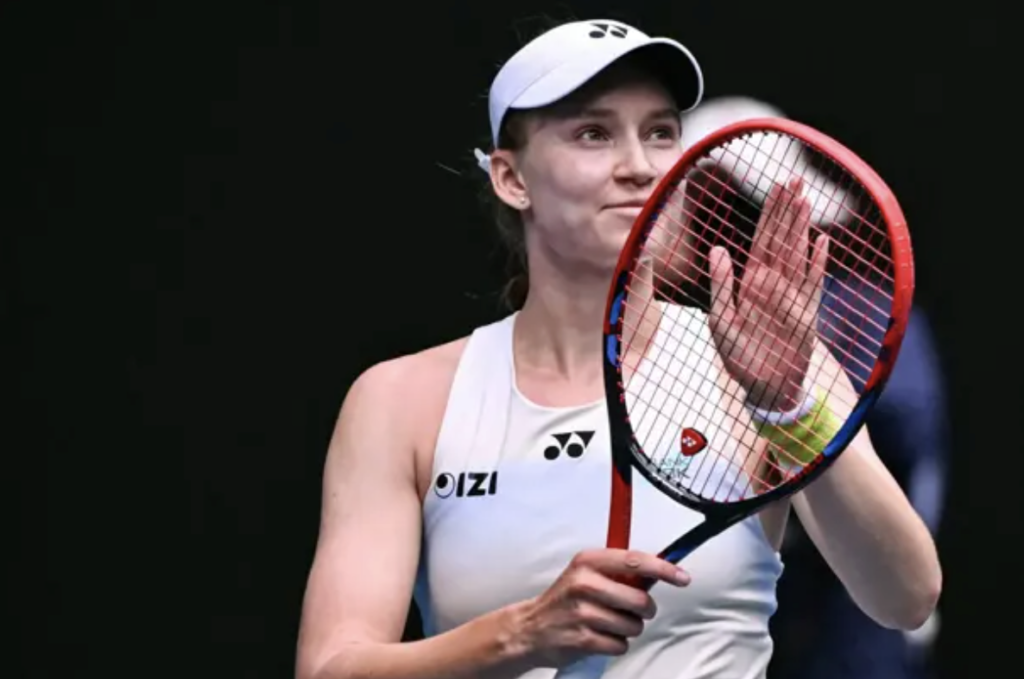
Elena Rybakina continues to confirm that her tennis is operating on a different frequency in Melbourne. In one of the most anticipated quarterfinals of the Australian Open 2026, the Kazakh player delivered a commanding performance to defeat world No. 2 Iga Swiatek 7–5, 6–1, bringing an abrupt end to the Pole’s title hopes and booking her place in the semifinals, where she will face Jessica Pegula.
Gettyimages
The victory was not only significant because of the opponent Rybakina overcame, but also because of the authority with which she did it. Against one of the most consistent and physically imposing players on the WTA Tour, Rybakina imposed her rhythm, controlled the key moments, and gradually turned a tight contest into a one-sided affair.
A Tense Opening Set Decided by Margins
The match began with visible tension on both sides. Swiatek and Rybakina traded early service breaks, a reflection of the nerves and the importance of the occasion. Swiatek attempted to drag the rallies into longer exchanges, relying on her movement and consistency from the baseline, while Rybakina looked to shorten points whenever possible, using her flat groundstrokes and first-strike tennis.
Neither player was able to dominate behind the serve in the opening stages. First-serve percentages were low, forcing both to attack second serves aggressively. The set remained on serve until the closing games, when Rybakina showed greater composure under pressure. After saving multiple break points earlier in the set, she found her opening in the twelfth game, breaking Swiatek to take the set 7–5 after more than an hour of play.
That breakthrough proved decisive, not only on the scoreboard but also psychologically.
Rybakina Frees Her Game in the Second Set
With the first set secured, Rybakina played with noticeably more freedom. Her serve, which had been inconsistent early on, suddenly became a dominant weapon. She increased her first-serve percentage, won a high proportion of points behind it, and began to dictate play with her forehand.
Swiatek, by contrast, struggled to find solutions. The Polish star, a six-time Grand Slam champion, committed 25 unforced errors across the match and was unable to generate the depth and variation needed to disrupt Rybakina’s timing. In the second set, Rybakina raced to a 3–0 lead and never looked back, closing it out 6–1 without facing a single break point.
Statistically, the contrast was clear. Rybakina finished with 25 winners and only 19 unforced errors, while Swiatek managed just 10 winners. The numbers reflected what was visible on court: one player stepping into the ball with conviction, the other increasingly rushed and reactive.
“I Tried to Stay Aggressive”
Speaking after the match, Rybakina highlighted the importance of sticking to her identity as a player.
“I’m really happy with the win,” she said on court. “We know each other well, and I tried to stay aggressive. In the first set, neither of us served that well, so we were both trying to attack on the second serve. In the second set, I served better, played more freely, and that made the difference.”
Her words captured the essence of the contest. Once Rybakina gained confidence in her serve, the match tilted decisively in her favor.
A Return to the Business End of Grand Slams
This semifinal appearance marks Rybakina’s first at a Grand Slam since Wimbledon 2024, underlining her return to peak form. Already a Grand Slam champion at Wimbledon in 2022 and a finalist at the Australian Open in 2023, she has built a résumé that places her firmly among the most dangerous players on hard courts.
Her recent form only reinforces that status. Over the past few months, Rybakina has compiled an impressive run of results, winning 18 of her last 19 matches, many of them against top-10 opponents. The win over Swiatek was her most convincing statement yet in Melbourne.
A Semifinal Clash with Pegula Awaits
Next for Rybakina is a semifinal showdown with Jessica Pegula, who advanced after defeating Amanda Anisimova. Pegula’s game, based on consistency, anticipation, and emotional control, presents a very different challenge from Swiatek’s heavy topspin and relentless defense.
The matchup promises a fascinating contrast of styles: Rybakina’s power and first-strike efficiency against Pegula’s counterpunching and tactical discipline. Both players are seeking to solidify their place at the top of the women’s game, and both arrive with genuine belief.
A Player at the Peak of Her Powers
Right now, it is difficult to argue that anyone is playing better tennis than Elena Rybakina. Her performance against Swiatek was not just a victory — it was a demonstration of control, confidence, and competitive clarity.
If she maintains this level, the Australian Open title is no longer a distant possibility but a very real objective. In Melbourne, Rybakina is not just surviving the draw — she is shaping it.